
Instaforex Analysis

Forex broker related topics and discussions

Re: Instaforex Analysis

Postby IFX Bella » Tue Nov 18, 2025 3:02 am

Forex Analysis & Reviews: Trading Recommendations and Analysis for EUR/USD on November 18: A Correction Can't Hurt

Analysis of EUR/USD 5M
Image

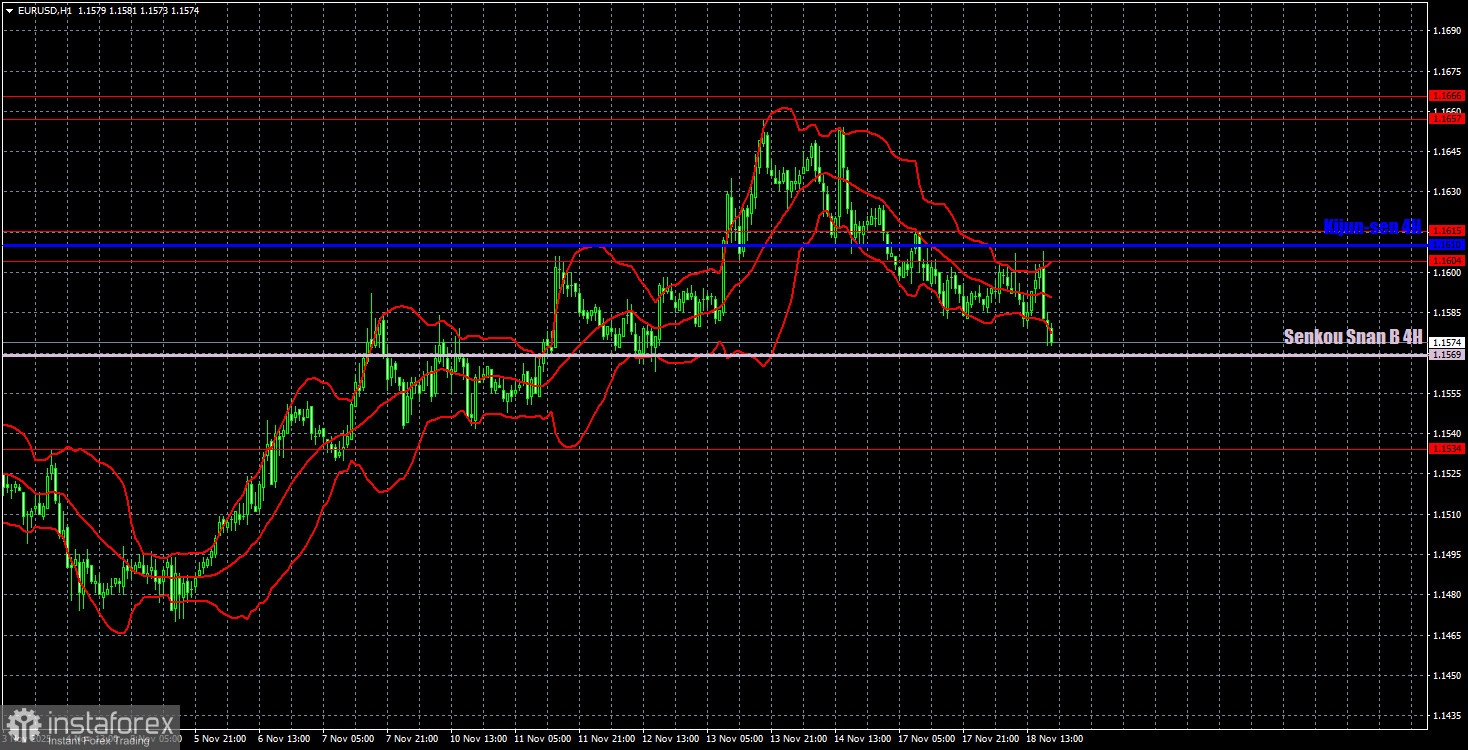
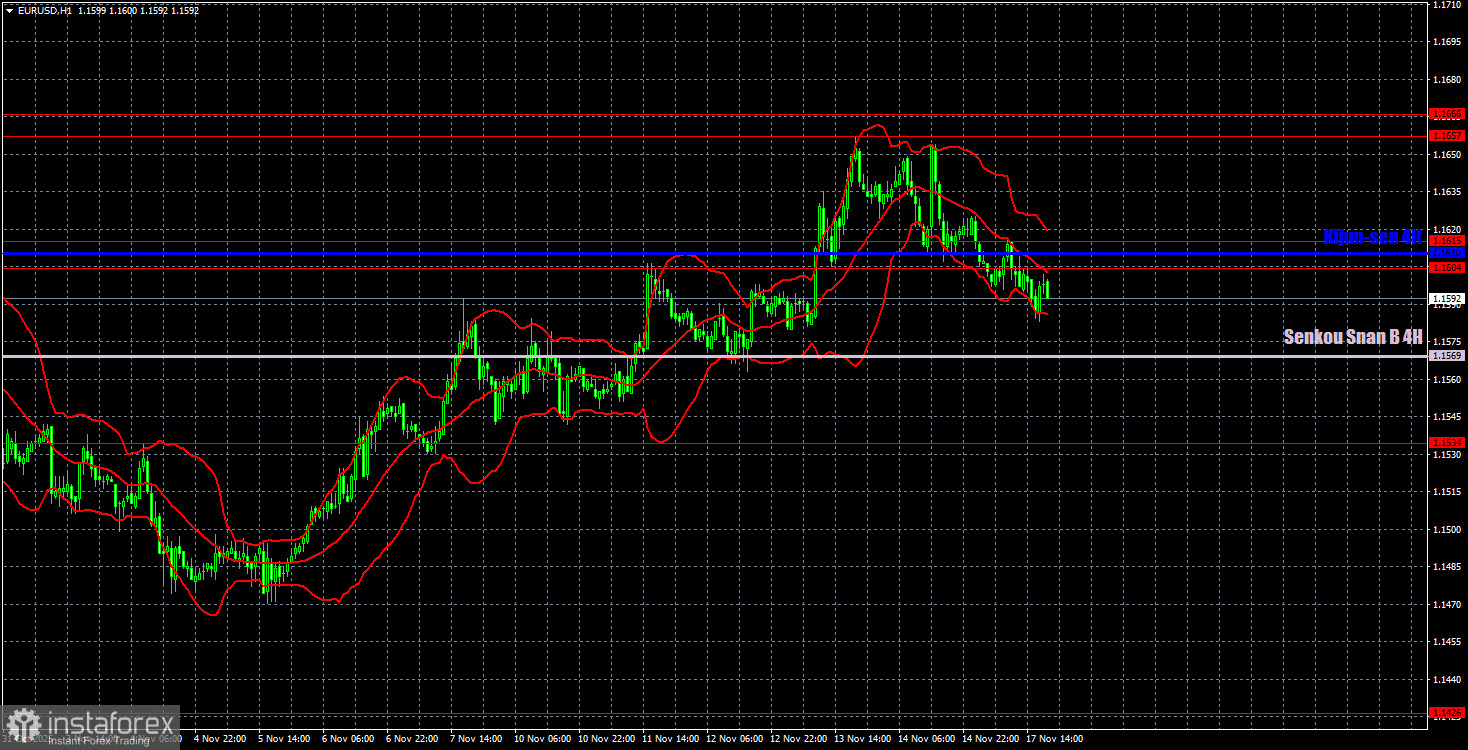
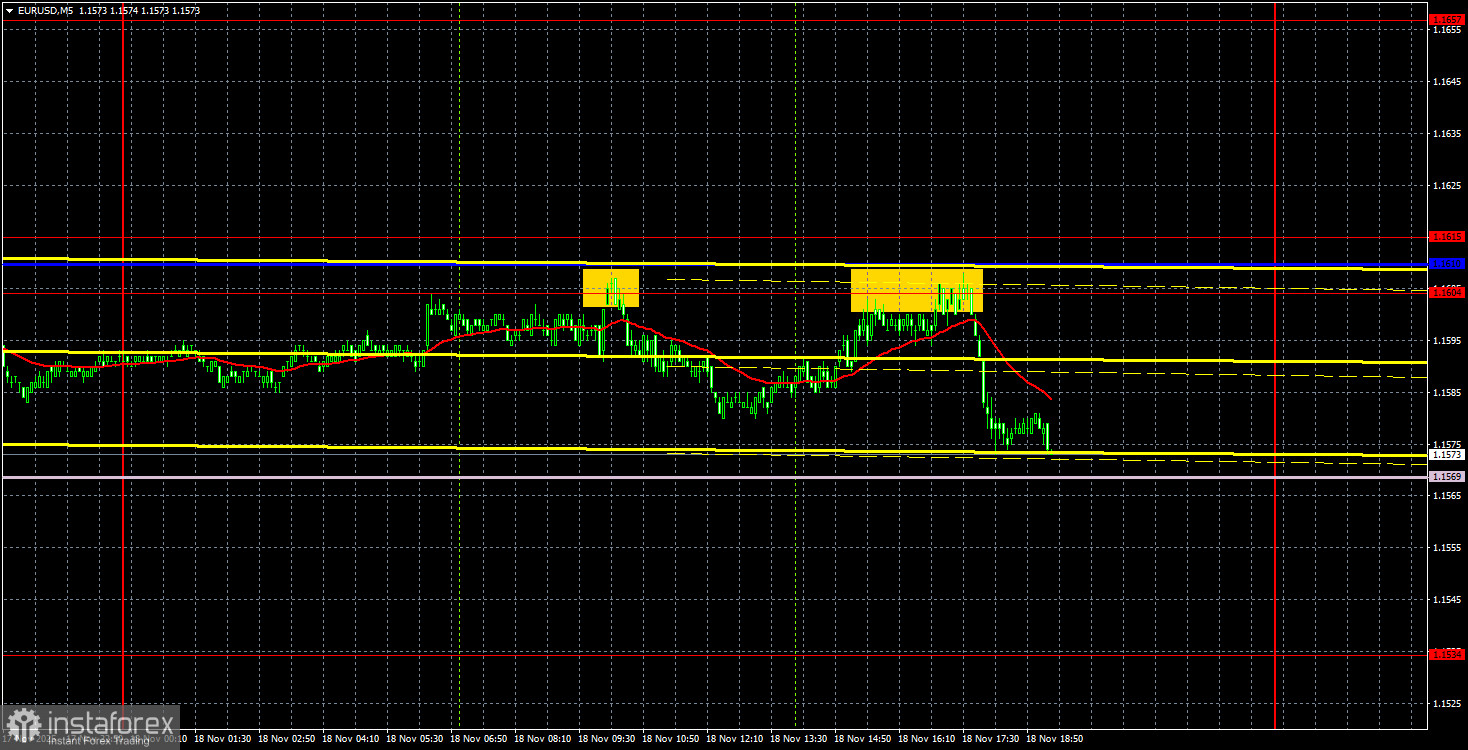
On Monday, the EUR/USD currency pair saw a minor pullback. Over the past week and a half, the euro has been slowly but steadily rising, recovering from the unjustified decline of the previous one-and-a-half months. Therefore, a minor correction within the local upward trend would not be detrimental. However, it is essential to note that the concept of trend is quite conditional, even on the hourly timeframe. The daily chart continues to show a global flat that has persisted for three months. Thus, any internal movement is a correction against a correction against a correction. The ascending trend on the hourly timeframe remains intact, as the price continues to stay above the Senkou Span B line. There is no clear trend line at the moment, but one could be constructed from the current correction. The fundamental and macroeconomic backdrop was absent on Monday, which once again explains the market's low volatility. The most important macroeconomic data in the U.S. is still not being published, and all other reports for the week are not significant under the current circumstances. The market is focused on what decision the Fed will make in December. To answer this question, statistics on the labor market and unemployment are needed. On the 5-minute timeframe, we see that for most of Monday, the pair traded sideways between the Kijun-sen line and the 1.1615 level. During the American trading session, the price consolidated below the Kijun-sen line; however, was it worth opening trades with such low volatility and with the Senkou Span B line 30 pips below?

COT Report
Image

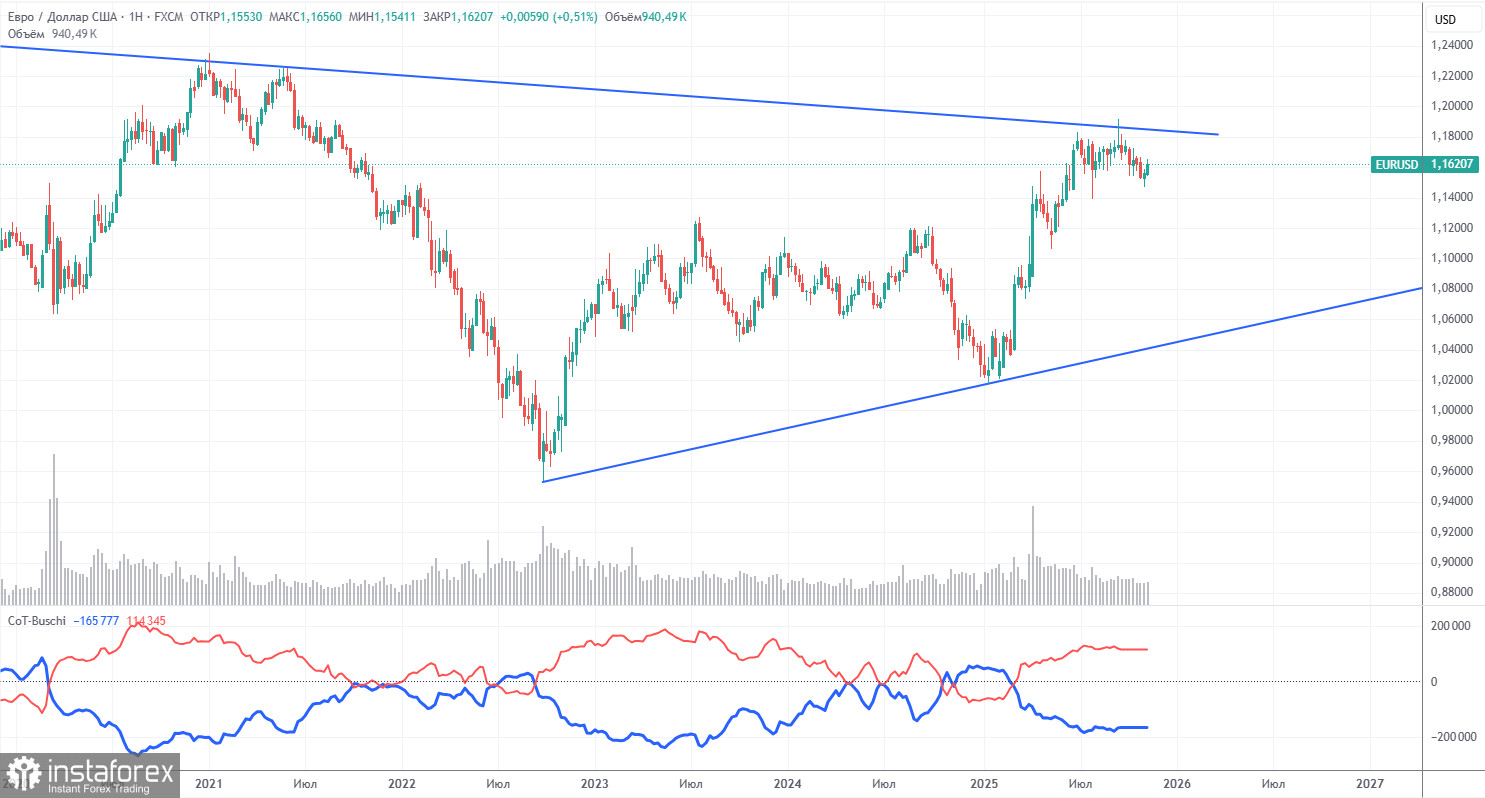
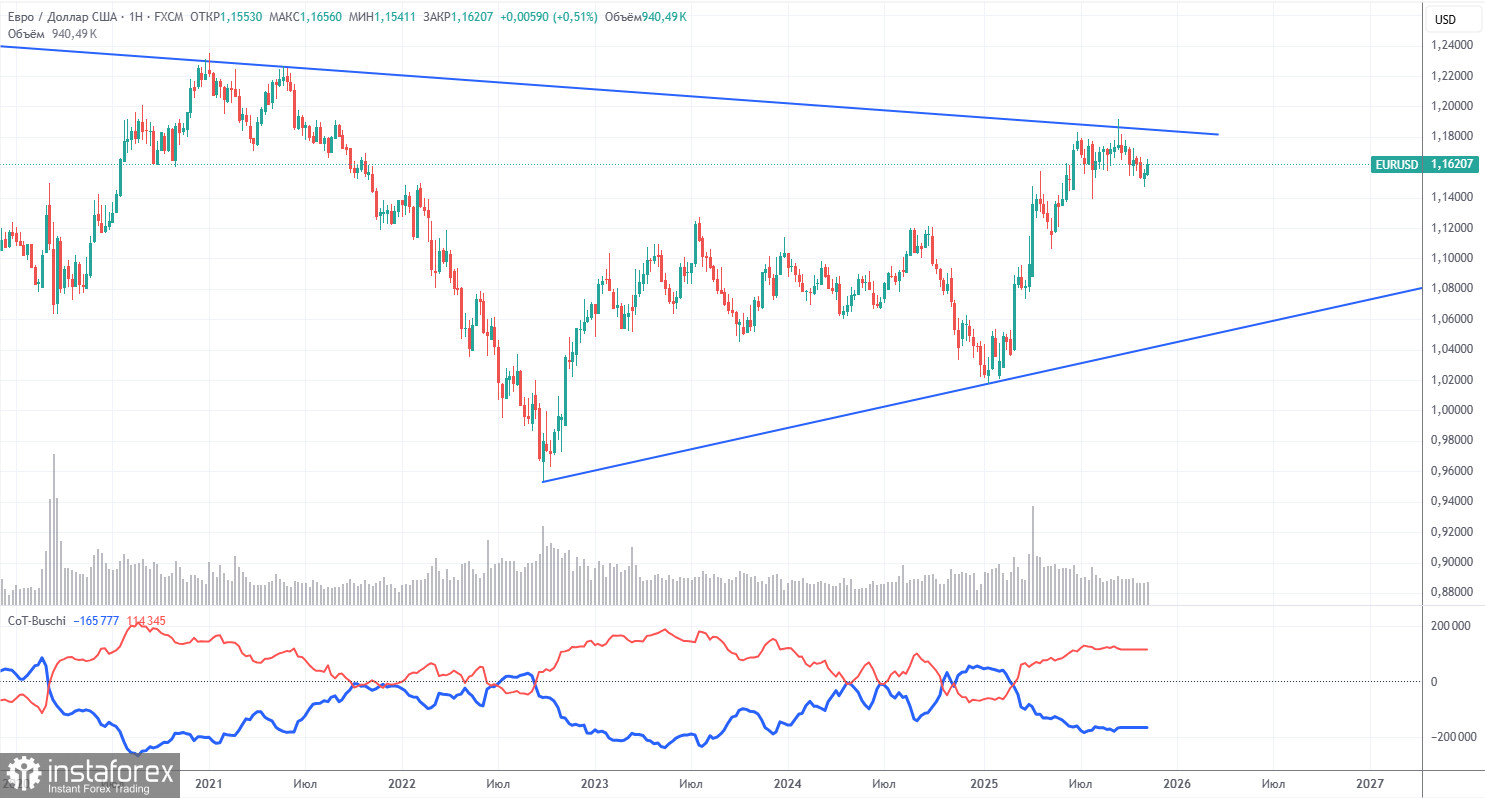
The latest COT report is dated September 23. Since then, no further COT reports have been published due to the U.S. "shutdown." In the illustration above, it is clear that the net position of non-commercial traders has long been "bullish," with bears struggling to gain the upper hand at the end of 2024 but quickly losing it. Since Trump took office for a second term as President of the U.S., the dollar has been falling. We cannot assert that the decline of the American currency will continue with 100% probability, but current world events suggest that this may be the case. We still do not see any fundamental factors that would strengthen the euro, while there remain sufficient factors that would weaken the dollar. The global downtrend is still ongoing, but what difference does it make where the price moved in the last 17 years? Once Trump concludes his trade wars, the dollar may start to rise, but recent events indicate that the war will continue in one form or another for a long time yet. The position of the red and blue lines of the indicator continues to indicate the preservation of a "bullish" trend. During the last reporting week, the number of long positions in the "Non-commercial" group decreased by 800, while the number of shorts increased by 2,600. Consequently, the net position decreased by 3,400 contracts over the week. However, this data is already outdated and holds no significance. Analysis of EUR/USD 1H

On the hourly timeframe, the EUR/USD pair continues to form a new upward trend. The current growth of the euro does not align with the local macroeconomic backdrop and fundamentals, but does correspond with the global context. The price remains within the daily range of 1.1400–1.1830, suggesting that a rise in the euro towards 1.1800 can be expected even within this local trend. For November 18, we highlight the following significant levels for trading: 1.1234, 1.1274, 1.1362, 1.1426, 1.1534, 1.1604-1.1615, 1.1657-1.1666, 1.1750-1.1760, 1.1846-1.1857, 1.1922, 1.1971-1.1988, as well as the Senkou Span B line (1.1569) and Kijun-sen (1.1610). The Ichimoku indicator lines may shift throughout the day, which should be taken into account when determining trading signals. Don't forget to set Stop Loss orders to break even once the price moves in the correct direction by 15 pips. This will safeguard against potential losses if the signal turns out to be false. On Tuesday, no significant or interesting events or reports are scheduled in the Eurozone or the U.S. Therefore, volatility is unlikely to rise significantly above the average of around 50 pips. Throughout the day, the pair may trade predominantly sideways. Trading Recommendations: On Tuesday, traders may open long positions if there is a consolidation above the 1.1604–1.1615 range, targeting 1.1657–1.1666. A bounce from the Senkou Span B line will also provide an opportunity for long positions. Short positions will become relevant if the price consolidates below the Senkou Span B line, with a target at 1.1534. Explanations for Illustrations: Support and resistance price levels are shown as thick red lines, near which the movement may end. They are not sources of trading signals. Kijun-sen and Senkou Span B lines are lines from the Ichimoku indicator transferred to the hourly timeframe from the 4-hour timeframe. They are strong lines. Extreme levels are thin red lines from which the price previously bounced. They are sources of trading signals. Yellow lines are trend lines, trend channels, and any other technical patterns. Indicator 1 on COT charts represents the size of each category of traders' net position.

Read more: https://ifxpr.com/4qZQ1eJ
IFX Bella
 
Posts: 540
Joined: Sat Dec 08, 2012 12:39 am

Re: Instaforex Analysis

Postby IFX Bella » Wed Nov 19, 2025 3:24 am

Forex Analysis & Reviews: Trading Recommendations and Analysis for EUR/USD on November 19: Euro Descends to Dangerous Levels

Analysis of EUR/USD 5M

Image

The EUR/USD currency pair traded with very low volatility and a downward bias on Tuesday. By the end of the day, the pair reached the Senkou Span B line, and the future trend we will observe in the coming weeks depends on this level. It's important to remember that the daily timeframe remains in a flat, meaning movements within the sideways channel of 1.1400-1.1830 can be entirely random and not dependent on fundamentals or macroeconomics. However, there were no significant events or news during the first two days of the week. The current correction could be beneficial, as it may help form an ascending trend line based on its extremes. We still believe the price is long overdue for an upward move purely on technical grounds within the sideways channel. Yet, once again, movements within a flat can be completely random. This week, reports on Non-Farm Payrolls and unemployment levels will be published in the U.S. Thus, volatility may be higher tomorrow. However, this is unlikely to help traders, as market reactions may be ambiguous and chaotic, and it's impossible to predict the values of these reports at this time. In yesterday's 5-minute timeframe, two sell signals were formed. The price bounced twice from the 1.1604-1.1610 area, losing approximately 15-20 pips on each occasion. The first trade had difficulty securing a profit, while the second could easily be closed manually closer to the evening, around the Senkou Span B line.

COT Report

Image

The latest COT report is dated September 23. Since then, no further COT reports have been published due to the U.S. "shutdown." In the illustration above, it is clear that the net position of non-commercial traders has long been "bullish," with bears struggling to gain the upper hand at the end of 2024 but quickly losing it. Since Trump took office for a second term as President of the U.S., the dollar has been falling. We cannot assert that the decline of the American currency will continue with 100% probability, but current world events suggest that this may be the case. We still do not see any fundamental factors that would strengthen the euro, while there remain sufficient factors that would weaken the dollar. The global downtrend is still ongoing, but what difference does it make where the price moved in the last 17 years? Once Trump concludes his trade wars, the dollar may start to rise, but recent events indicate that the war will continue in one form or another for a long time yet. The position of the red and blue lines of the indicator continues to indicate the preservation of a "bullish" trend. During the last reporting week, the number of long positions in the "Non-commercial" group decreased by 800, while the number of shorts increased by 2,600. Consequently, the net position decreased by 3,400 contracts over the week. However, this data is already outdated and holds no significance.


Analysis of EUR/USD 1H

Image

On the hourly timeframe, the EUR/USD pair continues to form a new upward trend. The rise of the euro does not align with the local macroeconomic backdrop and fundamentals, yet it completely aligns with the global ones. The price remains within the daily timeframe's sideways channel of 1.1400-1.1830, so an increase in the euro towards 1.1800 can indeed be expected soon, even within a local trend. The key is to stay above the Senkou Span B line. For November 19, we highlight the following levels for trading: 1.1234, 1.1274, 1.1362, 1.1426, 1.1534, 1.1604-1.1615, 1.1657-1.1666, 1.1750-1.1760, 1.1846-1.1857, 1.1922, 1.1971-1.1988, as well as the Senkou Span B line (1.1569) and the Kijun-sen line (1.1610). The Ichimoku indicator lines may shift during the day, which should be taken into account when determining trading signals. Don't forget to set the Stop Loss order to breakeven if the price moves in the right direction by 15 pips. This will protect against potential losses if the signal turns out to be false. In the Eurozone, the second estimate of October inflation is scheduled for release on Wednesday and is unlikely to be of significant interest to anyone. In the evening, the publication of the latest FOMC meeting minutes is also considered a secondary event. We can say that the news today will be very weak. Trading Recommendations: On Wednesday, traders may open long positions in the event of a bounce from the Senkou Span B line with a target of 1.1604-1.1615. Short positions will become relevant upon a consolidation below the Senkou Span B line, with a target at 1.1534. Explanations for Illustrations: Support and resistance price levels are shown as thick red lines, near which the movement may end. They are not sources of trading signals. Kijun-sen and Senkou Span B lines are lines from the Ichimoku indicator transferred to the hourly timeframe from the 4-hour timeframe. They are strong lines. Extreme levels are thin red lines from which the price previously bounced. They are sources of trading signals. Yellow lines are trend lines, trend channels, and any other technical patterns. Indicator 1 on COT charts represents the size of each category of traders' net position.

Analysis are provided by InstaForex.


Read more: https://ifxpr.com/4a2pDuB
IFX Bella
 
Posts: 540
Joined: Sat Dec 08, 2012 12:39 am

Re: Instaforex Analysis

Postby IFX Bella » Thu Nov 20, 2025 3:47 am

Forex Analysis & Reviews: EUR/USD Overview. November 20. Wait Mode: Activated

Image

The EUR/USD currency pair traded very sluggishly for most of the day on Wednesday. This is not particularly surprising, as there were no significant events or reports scheduled for yesterday. We mentioned that the second estimate of inflation in the Eurozone carries little weight, and the FOMC minutes are even less relevant, as they are published three weeks after the actual meeting, making the information they contain outdated by the time they are released. As a result, the market once again had nothing to react to yesterday, and over the past few months, it has shown no desire to take the initiative. All analysis of the pair's movements now boils down to two points: volatility and flat conditions on the daily chart. These two concepts are interconnected, and it can be said that without one, there would be no other. Volatility is declining in both the short- and long-term. Thus, with each passing day, the market is trading less actively. What could this be attributed to? It is evident to all market participants that the fundamentals and macroeconomics are not to blame. Yes, we have not seen any important labor and unemployment reports in the U.S. for the past month and a half, but has that stopped the Federal Reserve from holding its meetings? On the contrary, the last two Fed meetings made "dovish" decisions, which have not hindered the dollar's growth. And what about the "shutdown"? Can it really be considered an ordinary event? What about various other reports and events in the world, particularly in the U.S.? Didn't Donald Trump introduce new tariffs in October? However, volatility continues to decline, and market movements remain illogical. There can be only one explanation for this: the flat state. Many traders view the flat as a coincidence. Many believe that a flat forms due to the absence of news or significant events. This is a major mistake. The flat forms for entirely different reasons. Let us recall that all movements of any instrument can be conditionally divided into trends and flats. As we all know, large players—market makers—dominate the market. Thus, periods of flat are characterized by the accumulation or distribution of positions by market makers. A trend is the realization of established deals. Simply put, large capital first accumulates its positions, and then movement begins when liquidity is insufficient to meet demand or supply. Therefore, the current flat on the daily timeframe is neither a coincidence nor a result of a weak news background. It represents the planned actions of major players. When they have fully established their positions, the trend will begin. We still believe that the trend is upward because it is extremely difficult to say why anyone would buy the dollar at this time. Consequently, in the current situation, the only option is to wait and... also accumulate positions. As the price approached the lower boundary of the flat—the 1.1400 level—this presents a good opportunity for long-term positions now.

Image

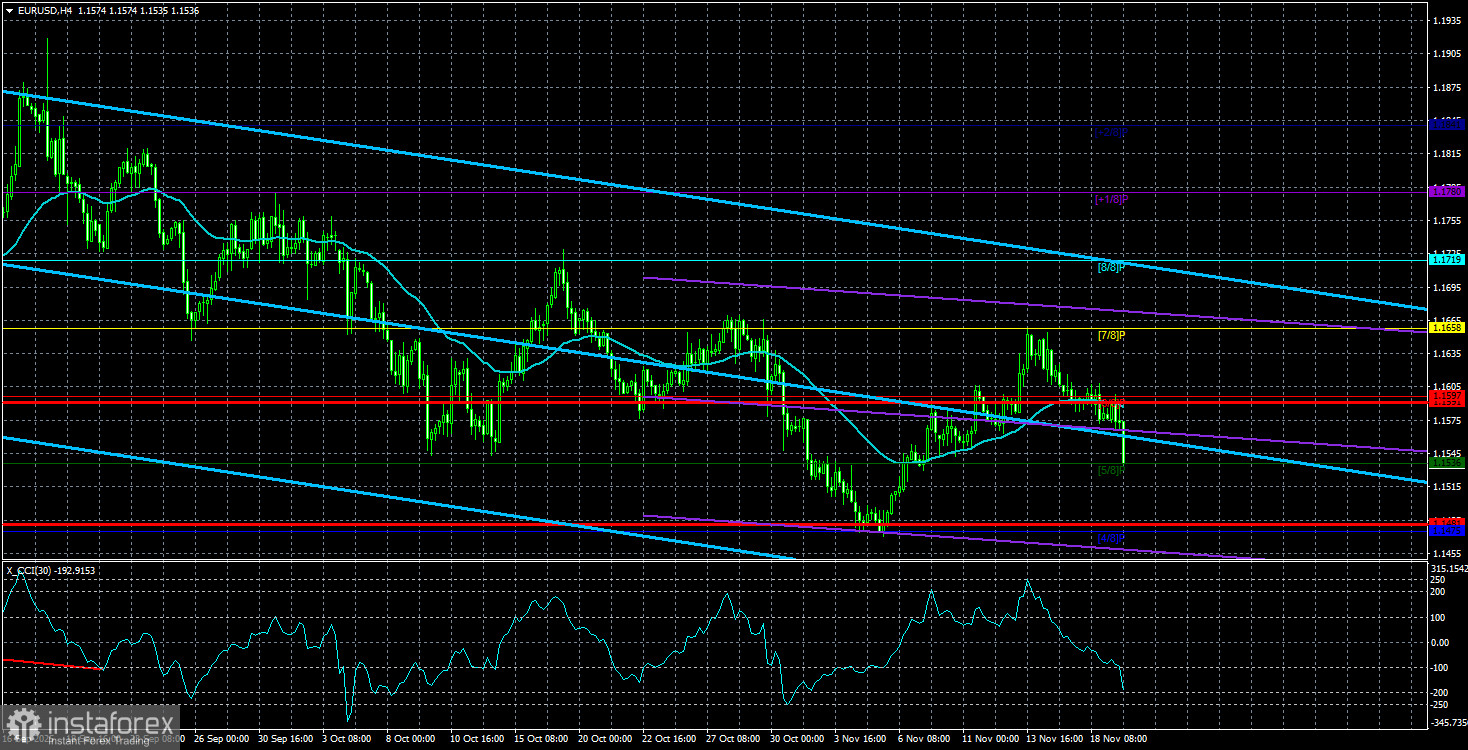
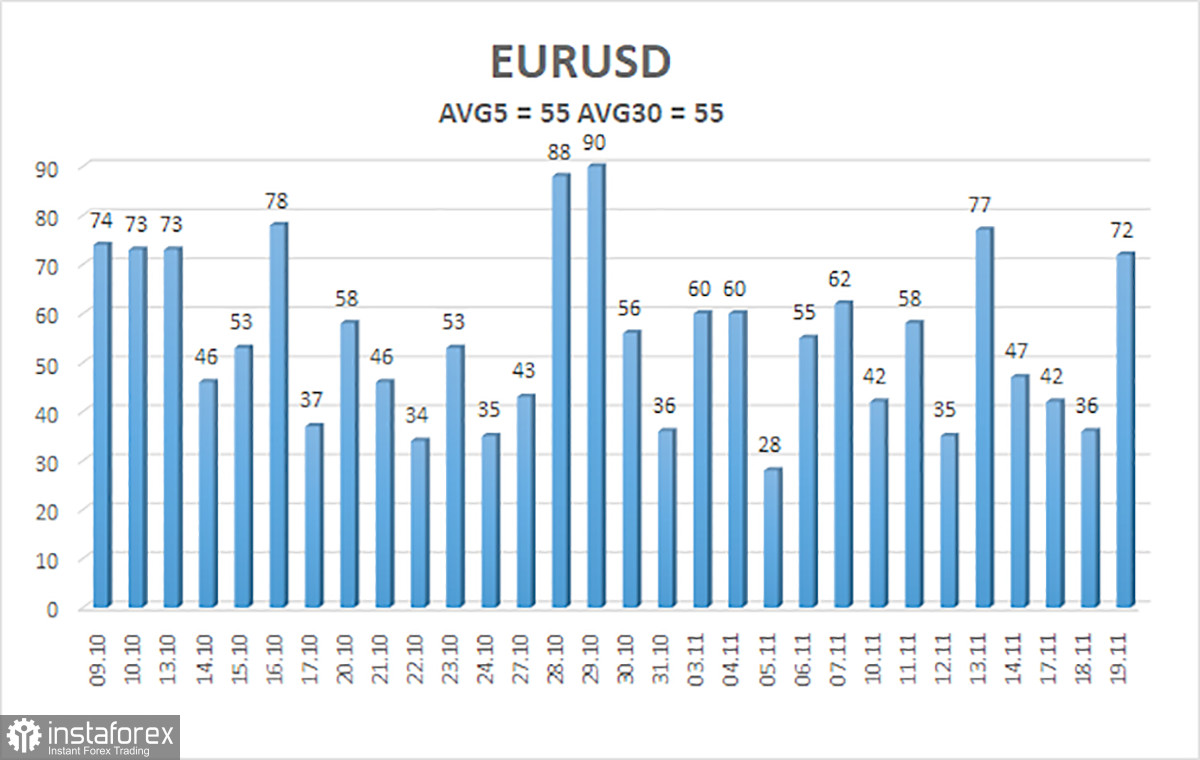
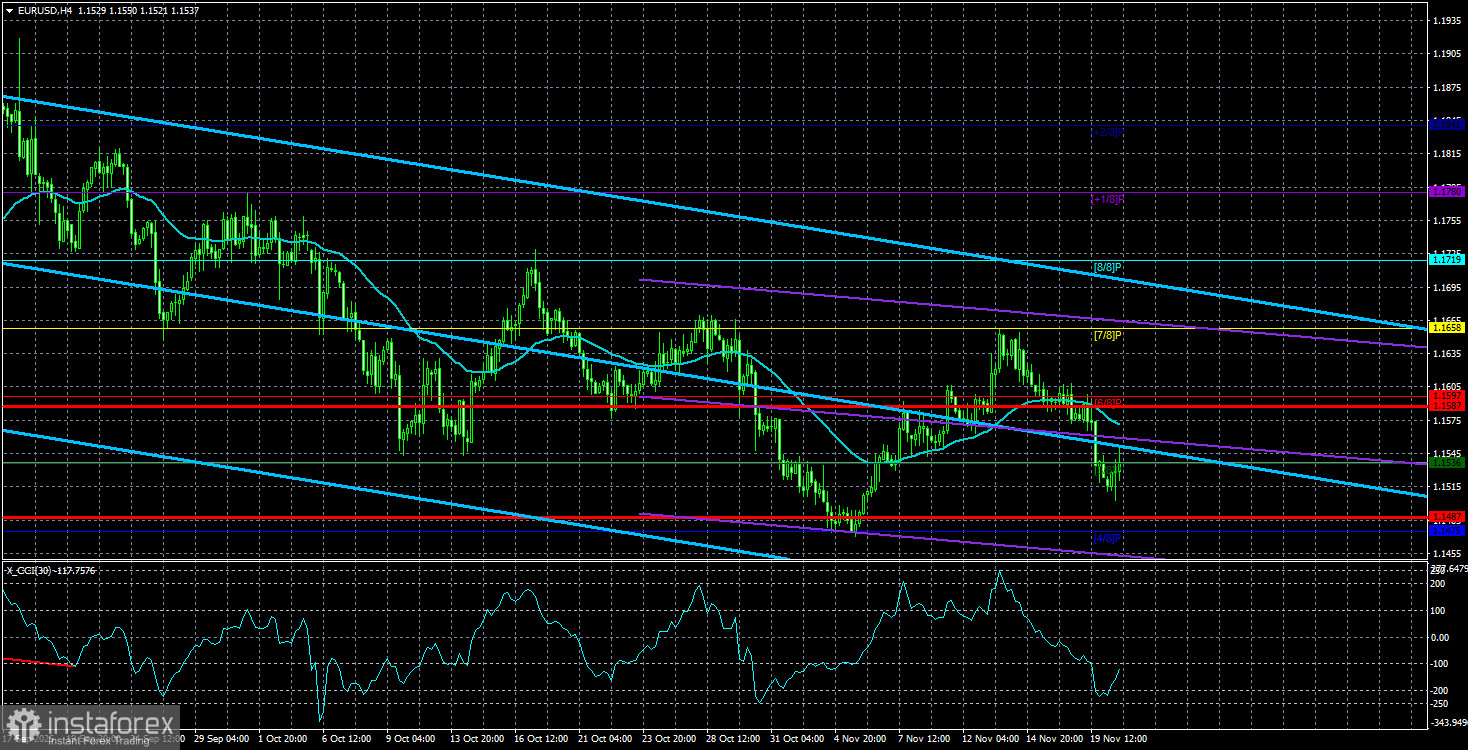
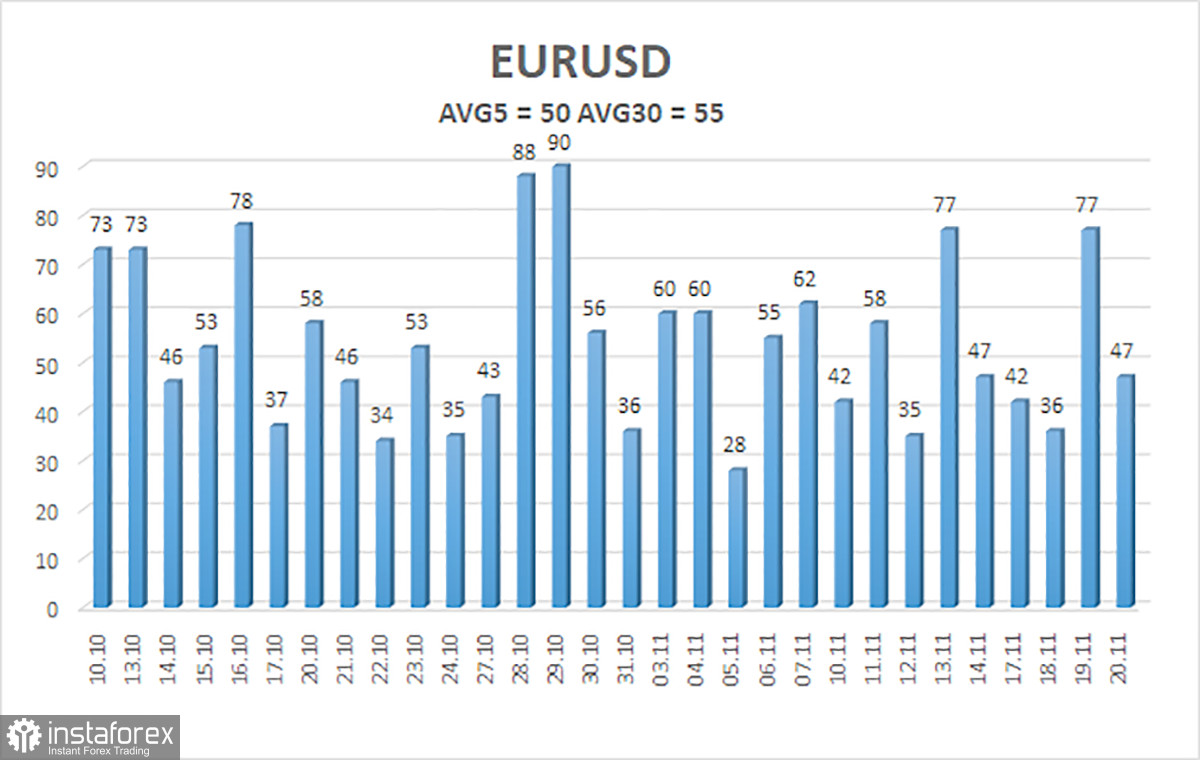
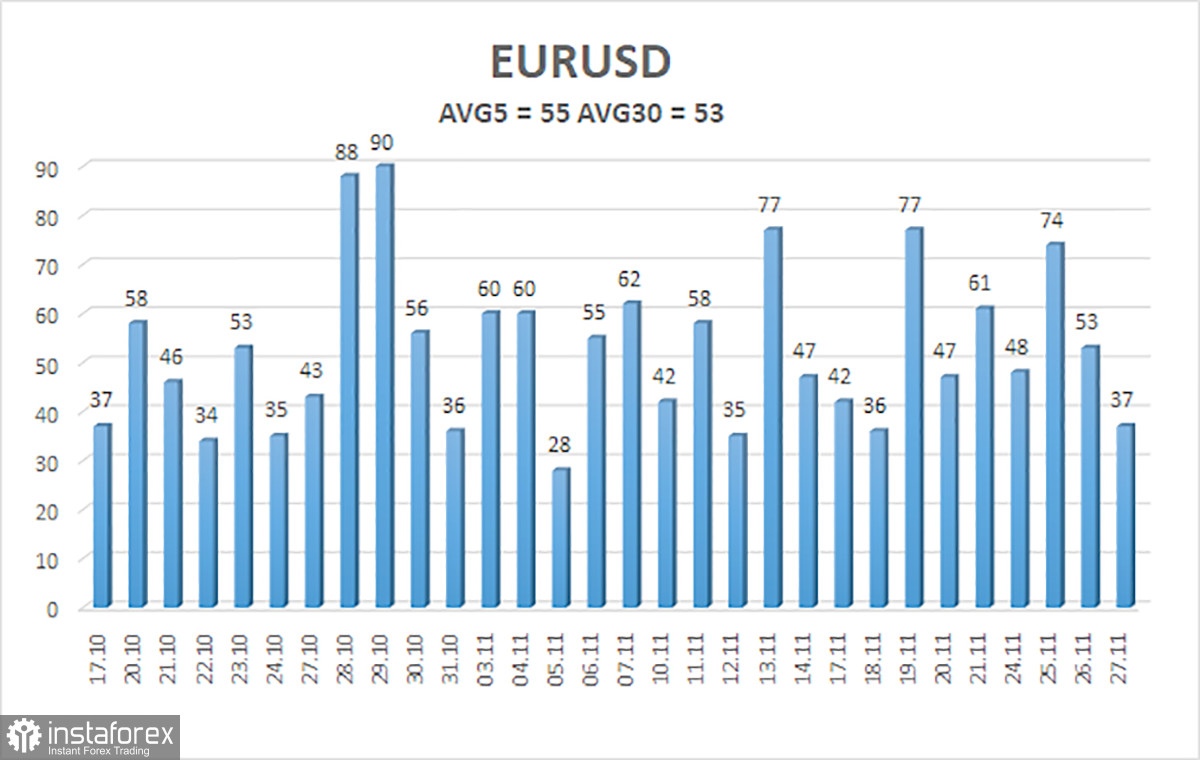
The average volatility of the EUR/USD currency pair over the last five trading days as of November 20 is 55 pips, which is considered "average." We expect the pair to trade between 1.1481 and 1.1591 on Thursday. The upper channel of the linear regression points downward, signaling a downward trend, but in fact the flat continues on the daily timeframe. The CCI indicator has entered the oversold area twice in October, which may provoke a new upward trend in 2025. In the near future, the indicator may enter the oversold territory for the third time. Nearest Support Levels: S1 – 1.1536 S2 – 1.1475 S3 – 1.1414 Nearest Resistance Levels: R1 – 1.1597 R2 – 1.1658 R3 – 1.1719 Trading Recommendations The EUR/USD pair has once again settled above the moving average, maintaining an upward trend on all higher timeframes, while a flat has persisted on the daily timeframe for several months. The U.S. dollar remains strongly influenced by global fundamental factors. Recently, the dollar has risen, but the reasons for this movement may be purely technical. If the price is below the moving average, small short positions can be considered targeting 1.1481 on purely technical grounds. Above the moving average, long positions remain relevant with a target of 1.1800 (the upper line of the flat on the daily timeframe). Explanations for Illustrations: Linear regression channels help determine the current trend. If both are directed in the same way, it indicates that the trend is currently strong. The moving average line (settings 20,0, smoothed) defines the short-term trend and the direction in which trading should currently be conducted. Murray levels are target levels for movements and corrections. Volatility levels (red lines) represent the likely price channel in which the pair will spend the following days, based on current volatility indicators. The CCI indicator entering the oversold territory (below -250) or overbought territory (above +250) indicates that a trend reversal in the opposite direction is approaching.

Analysis are provided by InstaForex.

Read more: https://ifxpr.com/49q8Am9
IFX Bella
 
Posts: 540
Joined: Sat Dec 08, 2012 12:39 am

Re: Instaforex Analysis

Postby IFX Bella » Fri Nov 21, 2025 1:51 am

Forex Analysis & Reviews: EUR/USD Overview. November 21. So Much Noise, So Little Change: The FOMC Minutes

Image

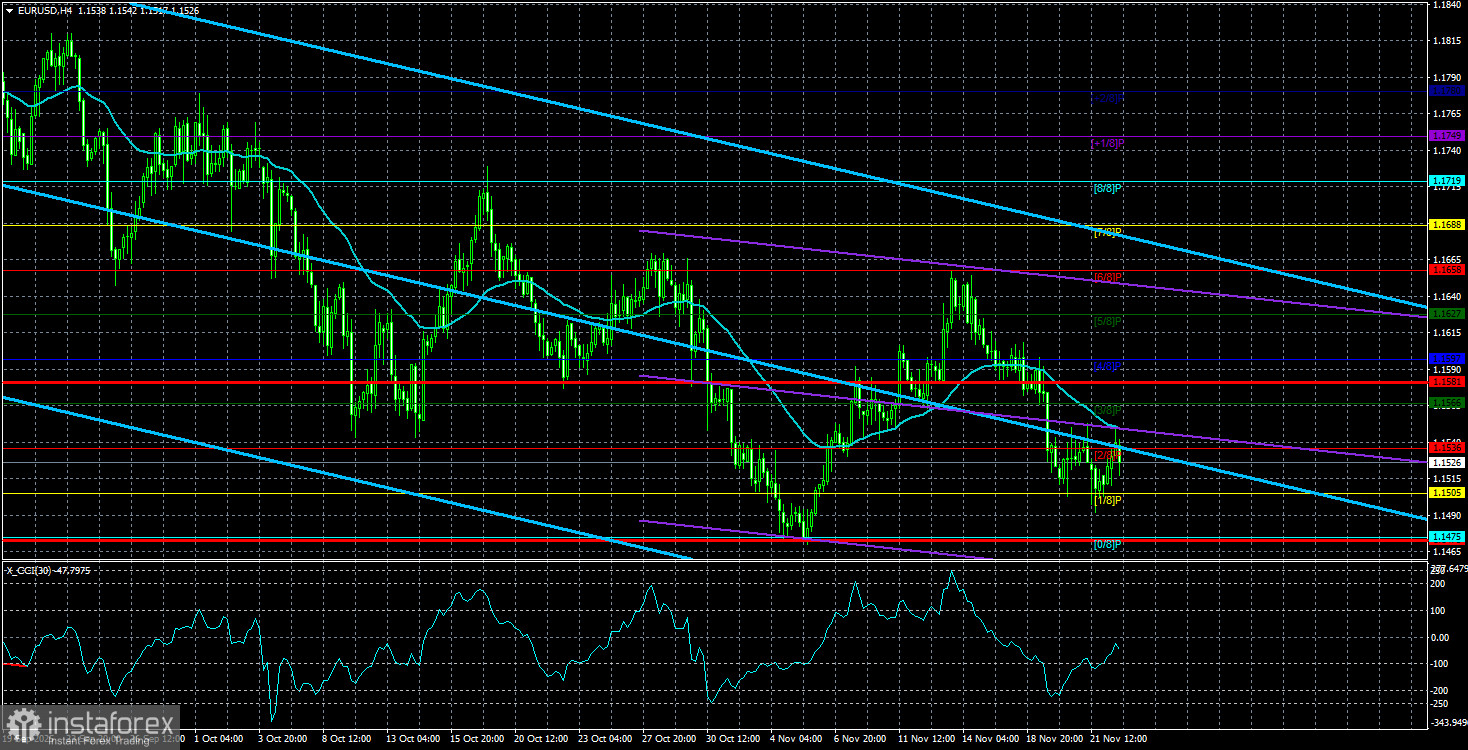
The EUR/USD currency pair continued its movement on Thursday, following the trend started the day before. In the second half of the day, the U.S. dollar appreciated again. The word "again" carries significant implications. In the first half of the year, when the American currency was plunging, we often said "the dollar has fallen again." But what justifies the dollar's rise for the second month in a row now? The only somewhat significant event on Wednesday was the FOMC minutes. This document is generally considered formal, and it rarely provokes a market reaction. Why? Because it is published three weeks after the actual FOMC meeting. At this time, a substantial amount of important macroeconomic information is released, undoubtedly influencing the central bank's mood. Moreover, the minutes do not contain any "secret" information; they merely reflect the sentiment of the monetary committee representatives, giving a snapshot of each official's views and expectations. However, the market had a million opportunities to familiarize itself with those views and expectations over the last three weeks. Speeches by committee members are not rare or surprising; their viewpoints are transparent, and that's normal. As a result, this document provided no new information to traders. Moreover, many experts reported that the dollar strengthened on Wednesday evening based on the "hawkish" minutes. It is important to note that the dollar began to appreciate at the opening of the U.S. session, and by the time the minutes were published in the evening, the strengthening of the dollar had already ceased (this is clearly visible on lower timeframes). So how could an unpublished protocol, whose content was unknown to anyone, lead to a dollar rise six hours earlier? This situation exemplifies what we've been discussing in recent weeks. The market found another formal factor supporting the American currency, and there was no consistency between the news and the movements on Wednesday. But why does the market need to move prices in certain directions that defy common sense? It is worth remembering that the market is influenced by market makers, who are not obligated to follow macroeconomic or fundamental indicators. This is why there are times when market movements do not align with either global factors or local macroeconomic data. We clearly state that movements right now are illogical, so traders should not harbor illusions or question something difficult to answer. Additionally, the daily timeframe continues to exhibit a flat. A flat always entails randomness, making movements within it illogical. The flat is not over; its lower boundary remains untested, so the dollar could very well experience another rise toward the 1.1400 level. We would like to say that everything is logical and the FOMC minutes were "hawkish," but that is not the case. All relevant information has been available to the market over the past three weeks. As a result, the dollar correction continues.

Image

The average volatility for the EUR/USD pair over the last five trading days as of November 21 is 50 pips and is characterized as "low." We expect the pair to trade between 1.1487 and 1.1587 on Friday. The upper channel of the linear regression is directed downward, signaling a bearish trend, but in fact, the flat continues on the daily timeframe. The CCI indicator has entered the oversold area twice in October, which could provoke a new upward trend in 2025. The indicator may soon enter the oversold area for a third time. Nearest Support Levels: S1 – 1.1475 S2 – 1.1414 S3 – 1.1353 Nearest Resistance Levels: R1 – 1.1536 R2 – 1.1597 R3 – 1.1658 Trading Recommendations: The EUR/USD pair has once again settled below the moving average, but an upward trend remains on all higher timeframes, while a flat has persisted on the daily timeframe for several months. The U.S. dollar remains strongly influenced by the global fundamental backdrop. Recently, the dollar has been rising, but the reasons for such movements may be purely technical. If the price is below the moving average, small short positions can be considered targeting 1.1487 on technical grounds. Above the moving average line, long positions remain relevant with a target of 1.1800 (the upper line of the flat on the daily timeframe).

Analysis are provided by InstaForex.

Read more: https://ifxpr.com/3LPy2rr
IFX Bella
 
Posts: 540
Joined: Sat Dec 08, 2012 12:39 am

Re: Instaforex Analysis

Postby IFX Bella » Mon Nov 24, 2025 2:54 am

Forex Analysis & Reviews: Trading Recommendations and Trade Analysis for EUR/USD on November 24. Contradictory Data in Favor of the Dollar

Analysis of EUR/USD 5M

Image

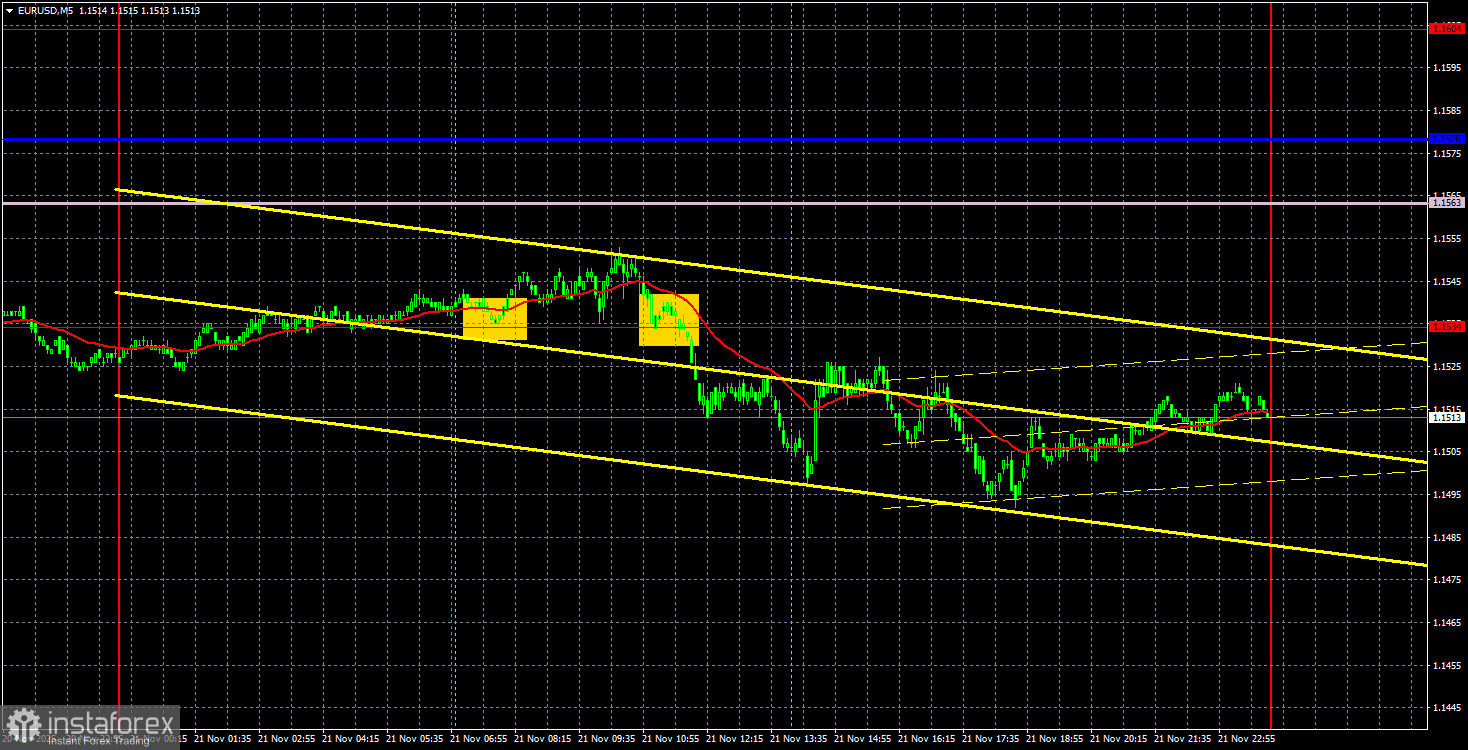
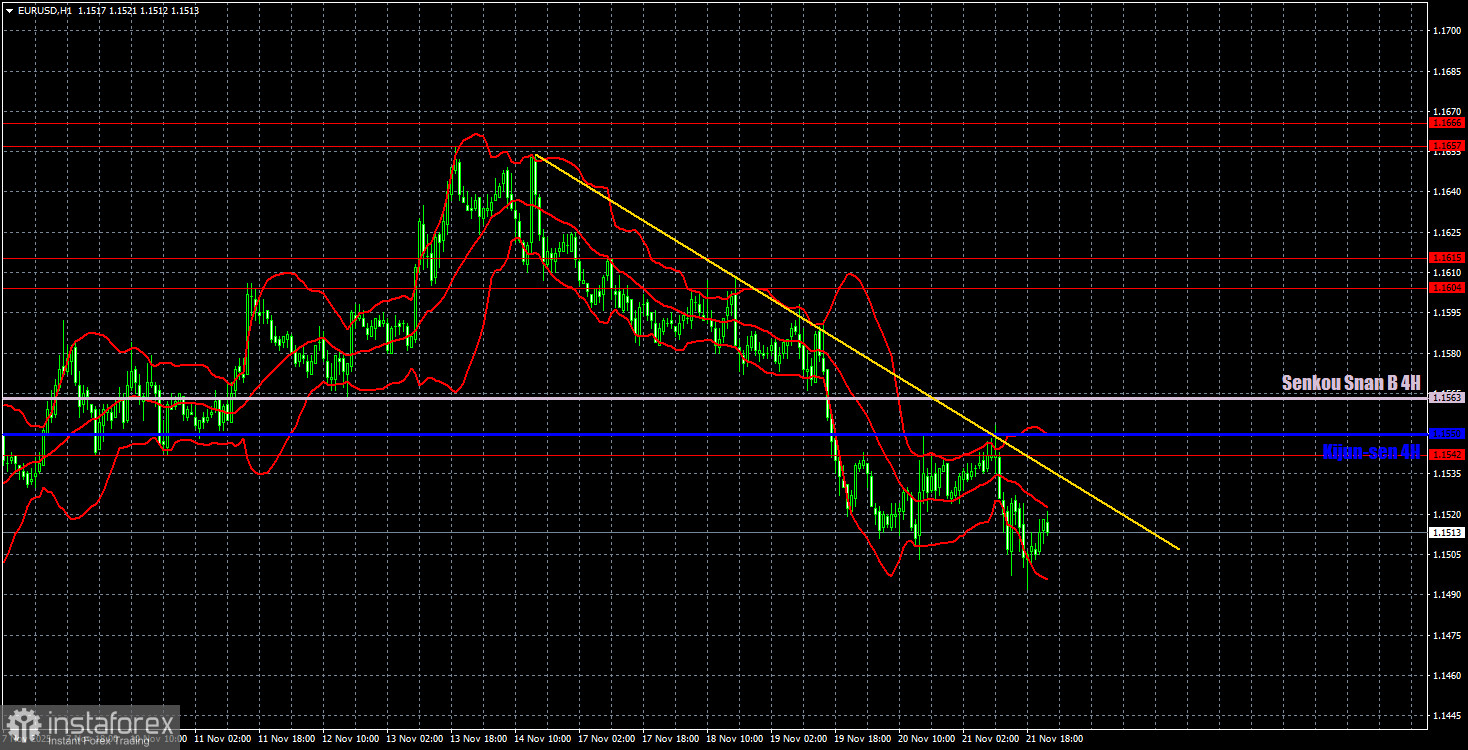
The EUR/USD currency pair traded lower again on Friday, despite the absence of any objective (even local) reasons for the decline. Indices of business activity in the services and manufacturing sectors were published for November in the Eurozone, Germany, and the U.S., and these reports were expected to assist traders on Friday. However, in reality, they, like the reports on the U.S. labor market and unemployment from the previous day, only added to the confusion. In Germany, the business activity index in the services and manufacturing sectors fell, contrary to expectations, while in the Eurozone, one index showed positive dynamics, while another showed negative dynamics. In the U.S., one index increased while the other declined. The University of Michigan consumer sentiment index fell to 51 points, even lower than forecasts. Overall, this statistical package cannot be interpreted in favor of the U.S. dollar. Nevertheless, the American currency rose slightly again, although very weakly, as volatility remains low. From a technical standpoint, a new trend line has formed on the hourly timeframe. A price consolidation above this line and a break above the Ichimoku indicator lines will signal to traders about another potential trend change to the upside, which we have seen four times in the last two months. Nonetheless, the global downward correction and the sideways movement on the daily timeframe must eventually come to an end. On the 5-minute timeframe Friday, two trading signals were generated: one buy signal (false) and one sell signal (correct). In both cases, the price moved in the right direction by a very small distance, but it was still possible to earn 15-20 pips on the short position, which covered the loss from the long position.

COT Report

Image

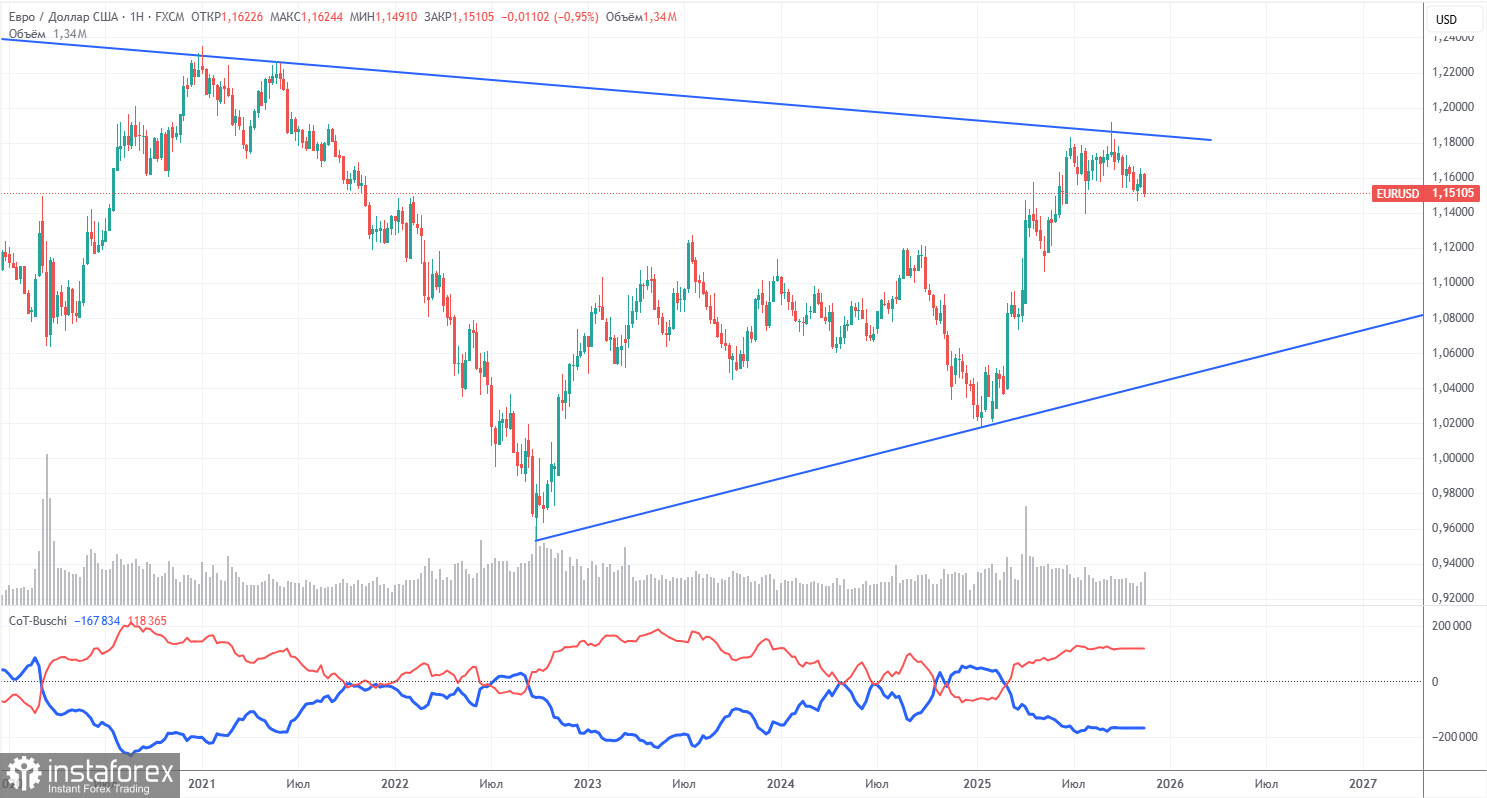
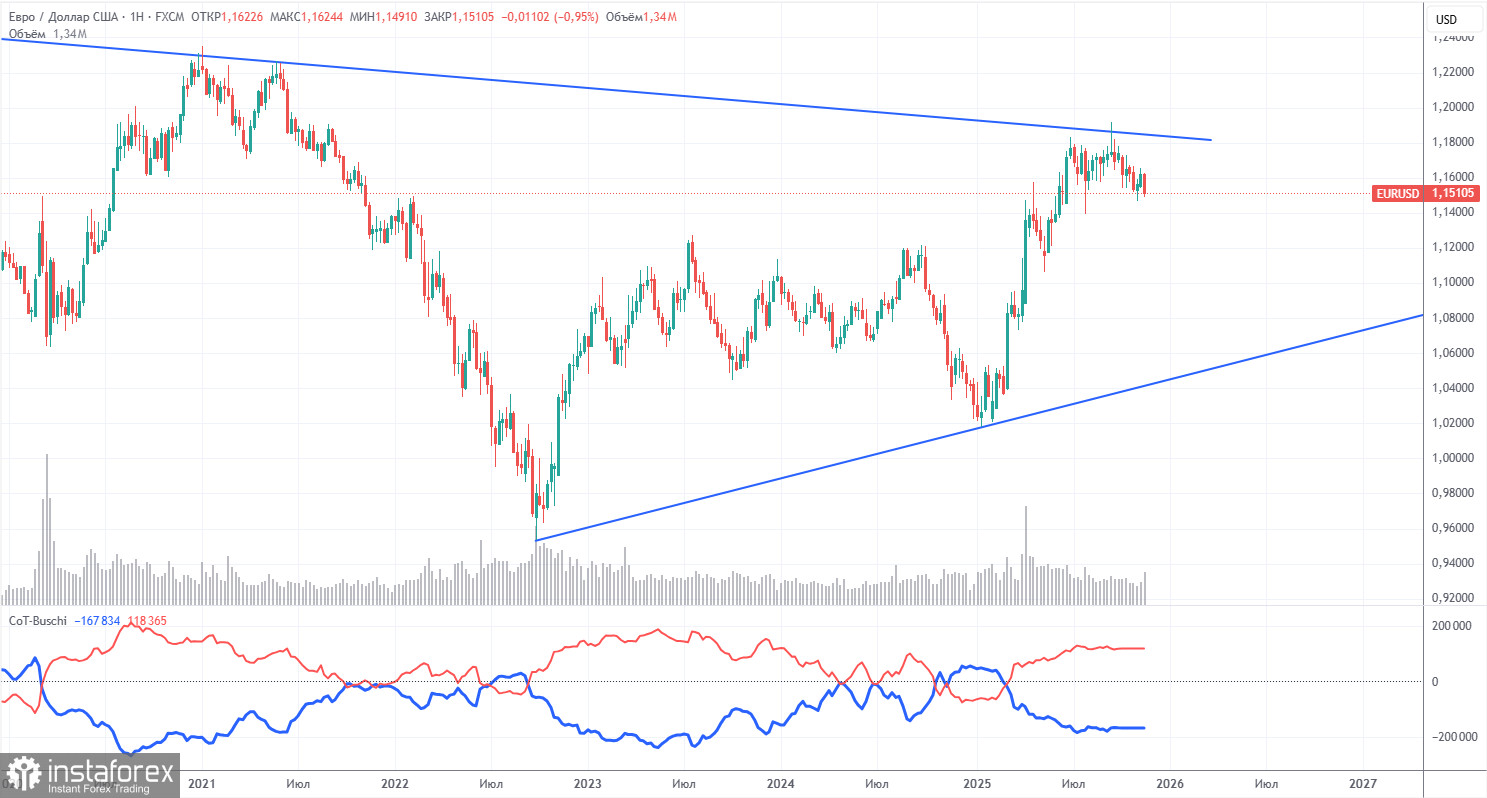
The last COT report was published last week and is dated October 7, making it, to put it mildly, outdated. The illustration above clearly shows that the net position of non-commercial traders has long been "bullish." Bears barely entered the zone of their own superiority at the end of 2024 but quickly lost it again. Since Trump took office for a second time, the dollar has been falling. We cannot say with 100% certainty that the decline of the U.S. currency will continue, but current global developments hint at just such a scenario. We still do not see any fundamental factors supporting the strengthening of the euro, but we do see enough factors supporting the decline of the dollar. The global downward trend still persists, but what significance does it have for the price movement over the last 17 years? The dollar could rise if the global fundamental picture changes, but currently, there are no signs of that. The positions of the red and blue lines in the indicator continue to show a bullish trend. Over the last reporting week, the number of longs in the "Non-commercial" group increased by 3,300, while the number of shorts increased by 2,400. Consequently, the net position increased by 900 contracts over the week. However, this data is already outdated and irrelevant.

Analysis of EUR/USD 1H

Image

On the hourly timeframe, the EUR/USD pair continues to form a new downward trend. The price remains within the sideways channel of 1.1400-1.1830 on the daily timeframe, so growth toward the 1.1800 level can still be expected soon, even within the framework of a local trend. However, for such a movement, a price consolidation above the Senkou Span B line and above the trend line is required. On November 24, we highlight the following trading levels: 1.1234, 1.1274, 1.1362, 1.1426, 1.1542, 1.1604-1.1615, 1.1657-1.1666, 1.1750-1.1760, 1.1846-1.1857, 1.1922, 1.1971-1.1988, as well as the Senkou Span B line (1.1563) and the Kijun-sen line (1.1550). The Ichimoku indicator lines may move during the day, which should be taken into account when determining trading signals. Remember to set a stop-loss order at breakeven if the price moves in the correct direction by 15 pips. This will protect against potential losses if the signal turns out to be false. On Monday, another speech by European Central Bank President Christine Lagarde is scheduled in the Eurozone, which is currently of little interest to anyone. In Germany, the business climate index will be published, which is not even a secondary indicator but a tertiary one. All signs point to renewed low volatility today. Trading Recommendations: On Monday, traders can trade from the level of 1.1542 in conjunction with the critical line. In the event of a rebound, consider selling; in the event of consolidation above the Senkou Span B line, consider buying. However, last week once again proved our constant observation—the market does not want to trade; volatility is low, and logical movements are still not being observed.

Analysis are provided by InstaForex.

Read more: https://ifxpr.com/3XKr6yi
IFX Bella
 
Posts: 540
Joined: Sat Dec 08, 2012 12:39 am

Re: Instaforex Analysis

Postby IFX Bella » Tue Nov 25, 2025 3:03 am

Forex Analysis & Reviews: EUR/USD Overview. Weekly Preview. The Market Will Struggle Again

Image

The EUR/USD currency pair traded very calmly on Monday. In the first half of the day, the euro gained slightly, but overall volatility remained low, and the pair showed no interesting movements. Thus, the market situation on the first trading day of the week remained unchanged. Could it change during the week? Looking ahead, the answer is: there is little chance of that. The flat trend on the daily timeframe persists, suggesting volatility is unlikely to increase significantly over the next four days, and movements are not expected to become much more logical. Moreover, the macroeconomic and fundamental backdrop this week will be quite sparse, and the market has been known to ignore even significant events and reports in recent weeks and months. On Monday morning, the German business climate index was published, the only report of the day. It can be said right away that the euro's morning growth was not related to this index. At least because the indicator's actual value was below expectations. In any case, this report cannot be considered important. What awaits us further in the week? Today, Germany will publish the third estimate of GDP for the third quarter, and even international event calendars do not mark this as an important event. In other words, it is unlikely that the third estimate will differ significantly from the second or first, and it is also unlikely to differ from expert forecasts. The German economy is either not growing quarter over quarter or growing very slowly. There will not be many reasons for optimism for the euro today. On Wednesday, the event calendar in Europe is completely empty, aside from the upcoming speeches from European Central Bank President Christine Lagarde and ECB Chief Economist Philip Lane. However, it is worth noting once again that when the central bank was actively easing monetary policy or considering changes to it, the speeches of Lagarde and Lane (as well as other ECB representatives) were important, as they could contain hints for traders about future rate decisions. However, now the ECB has 100% likely completed the easing process, so what can we expect from central bank officials? On Thursday, Germany will publish the consumer confidence index, which is also an entirely secondary indicator. On Friday, Germany will release retail sales, the unemployment rate, and the consumer price index. These are indeed important indicators, but they pertain to just one country in the Eurozone. Thus, a slight reaction to these reports may be possible, but even inflation currently attracts little interest, as the ECB has managed to stabilize it around 2%. Thus, we can conclude that Europe is unlikely to be a major source of important information or news this week. The hope lies solely on the U.S., but there, the calendar is clearly not saturated with macroeconomic releases and fundamental events.

Image

The average volatility of the EUR/USD currency pair over the last five trading days as of November 25 is 54 pips and is characterized as "medium-low." We expect the pair to trade between 1.1471 and 1.1581 on Tuesday. The upper channel of the linear regression is downward, signaling a downward trend, but in reality, the flat trend on the daily timeframe persists. The CCI indicator has entered the oversold region twice in October, which could provoke a new wave of upward trend in 2025. The indicator may enter the oversold area for the third time shortly. Nearest Support Levels: S1 – 1.1505 S2 – 1.1475 S3 – 1.1444 Nearest Resistance Levels: R1 – 1.1536 R2 – 1.1566 R3 – 1.1597 Trading Recommendations: The EUR/USD pair remains below its moving average, but an upward trend persists across all higher timeframes, while the daily timeframe has been flat for several months now. The global fundamental backdrop continues to exert a strong influence on the U.S. dollar. Recently, the dollar has been rising, but the reasons for this movement may be purely technical. When the price is below the moving average, small short positions can be considered with a target of 1.1475 on purely technical grounds. Long positions above the moving average remain relevant with a target of 1.1800 (the upper line of the flat on the daily timeframe). Explanations for Illustrations: Linear regression channels help determine the current trend. If both are directed in the same way, then the trend is currently strong; The moving average line (settings 20,0, smoothed) determines the short-term trend and the direction in which trading should currently be conducted; Murray levels are targeted levels for movements and corrections; Volatility levels (red lines) denote the probable price channel within which the pair will trade in the coming day, based on current volatility metrics; The CCI indicator entering the oversold area (below -250) or t

Analysis are provided by InstaForex.

Read more: https://ifxpr.com/43OfKgi
IFX Bella
 
Posts: 540
Joined: Sat Dec 08, 2012 12:39 am

Re: Instaforex Analysis

Postby IFX Bella » Wed Nov 26, 2025 2:20 am

Forex Analysis & Reviews: Trading Recommendations and Analysis for EUR/USD on November 26. Euro Rises, But For How Long?

Analysis of EUR/USD 5M


Image

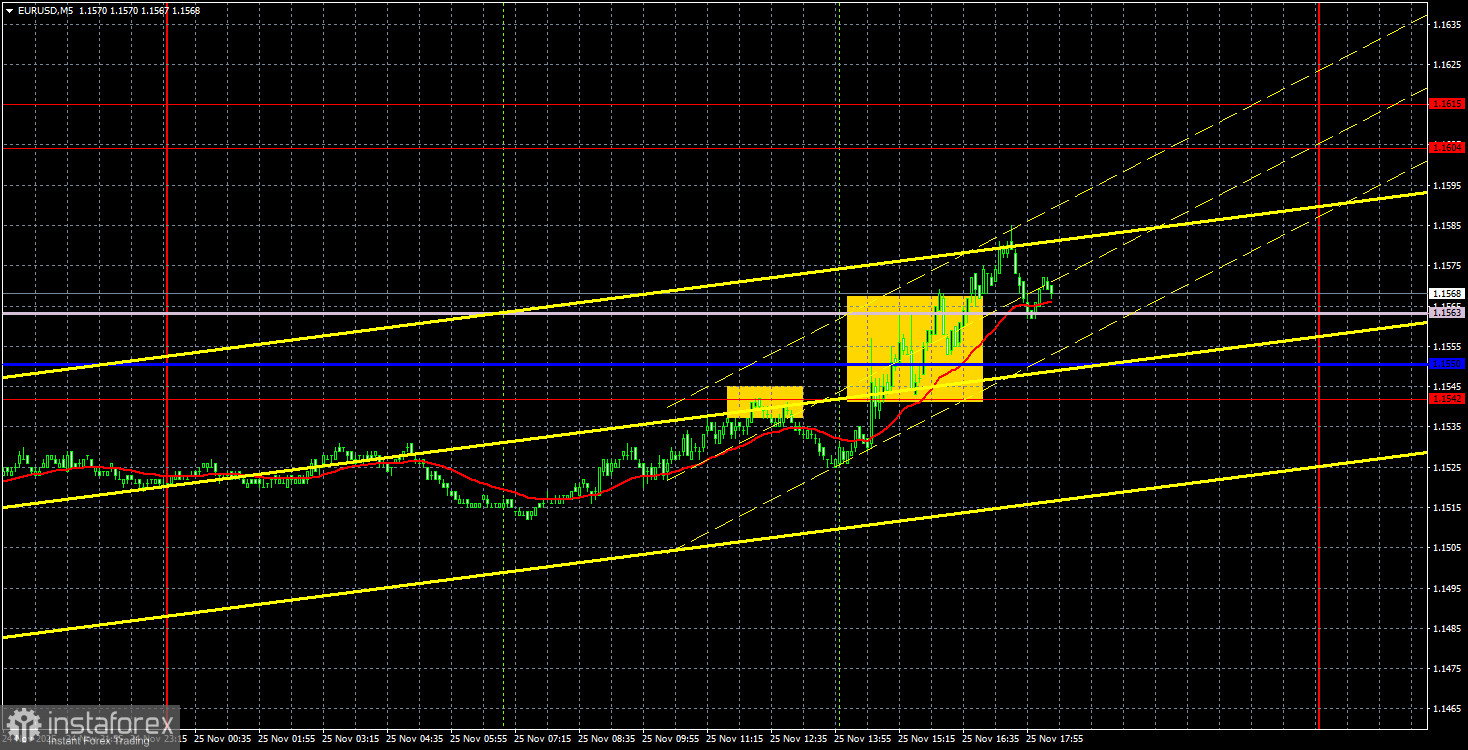
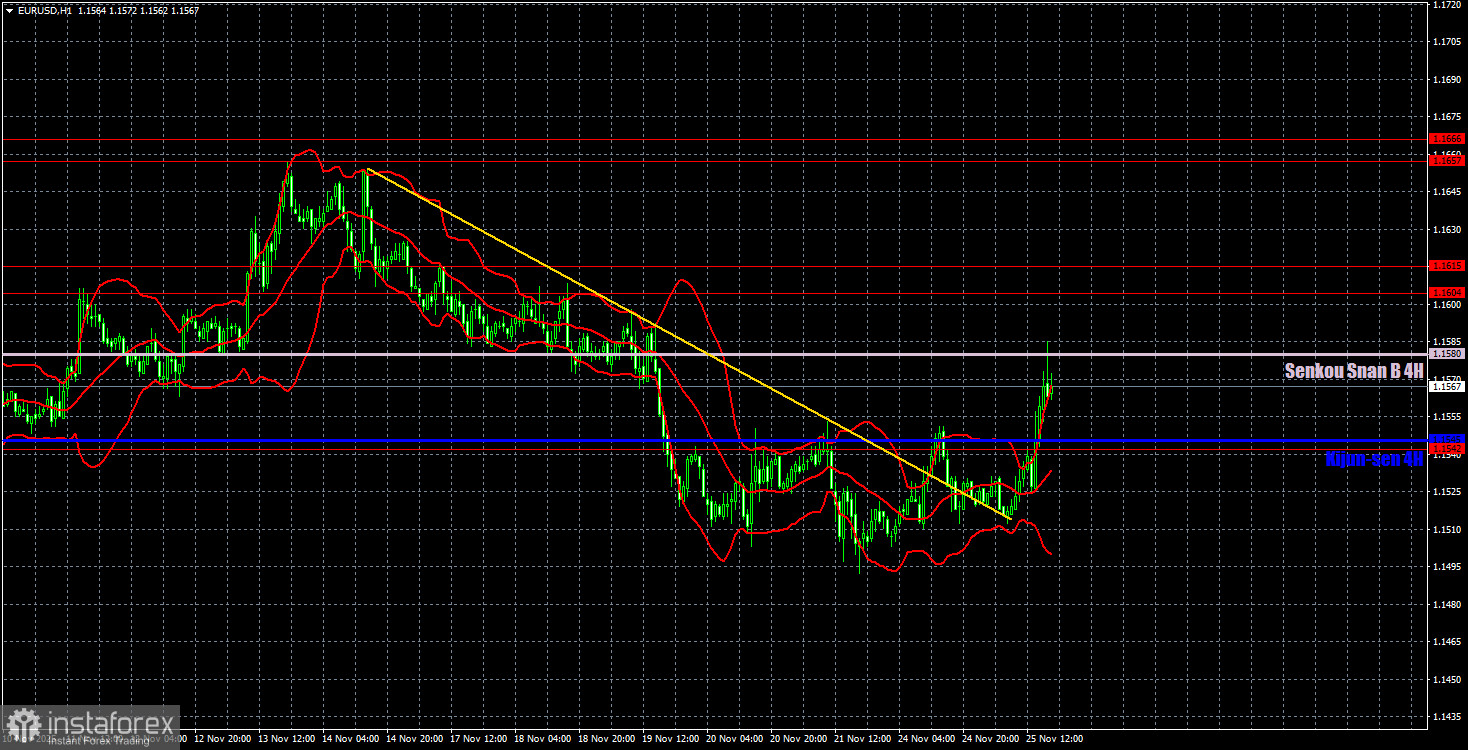
The EUR/USD currency pair started an upward move on Tuesday, and the market's reaction to the macroeconomic backdrop has finally become logical. To break it down, the price broke through and overcame another descending trend line, indicating further potential for price growth. Throughout the day, the euro indeed rose, significantly aided by the American reports. Retail sales data came in worse than forecasts, the ADP employment report was below expectations, and the producer price index did not upset the apple cart. Thus, we finally witnessed a decline in the dollar, but it ended swiftly near the Senkou Span B line. Therefore, it cannot yet be confidently claimed that the downward trend has ended, and the pair will not head towards the 1.1400 level, which is the lower boundary of the daily timeframe's sideways channel. On the 5-minute timeframe, two trading signals were formed yesterday, but they left much to be desired. Initially, the price bounced off the 1.1542 level, but it only dropped by 10 pips. Later, the pair broke through a range of levels and lines between 1.1542 and 1.1563, but again only moved up by 10 pips. Thus, yesterday's trading session can be deemed unsuccessful, as the downward trend is not completely broken, and the Senkou Span B line has not been overcome.

COT Report

Image

The last COT report was published last week and is dated October 7, making it, to put it mildly, outdated. The illustration above clearly shows that the net position of non-commercial traders has long been "bullish." Bears barely entered the zone of their own superiority at the end of 2024 but quickly lost it again. Since Trump took office for a second time, the dollar has been falling. We cannot say with 100% certainty that the decline of the U.S. currency will continue, but current global developments hint at just such a scenario. We still do not see any fundamental factors supporting the strengthening of the euro, but we do see enough factors supporting the decline of the dollar. The global downward trend still persists, but what significance does it have for the price movement over the last 17 years? The dollar could rise if the global fundamental picture changes, but currently, there are no signs of that. The positions of the red and blue lines in the indicator continue to show a bullish trend. Over the last reporting week, the number of longs in the "Non-commercial" group increased by 3,300, while the number of shorts increased by 2,400. Consequently, the net position increased by 900 contracts over the week. However, this data is already outdated and irrelevant.

Analysis of EUR/USD 1H

Image

On the hourly timeframe, the EUR/USD pair continues to form a downward trend despite breaking the trendline. The price remains within the sideways channel of 1.1400-1.1830 in the daily timeframe, so a rise in the euro to the level of 1.1800 can still be anticipated within the local trend. However, for such a movement, a price fixation above the Senkou Span B line is required. Without this, the pair may target 1.1400. For November 26, we highlight the following levels for trading: 1.1234, 1.1274, 1.1362, 1.1426, 1.1542, 1.1604-1.1615, 1.1657-1.1666, 1.1750-1.1760, 1.1846-1.1857, 1.1922, 1.1971-1.1988, as well as the Senkou Span B line (1.1580) and Kijun-sen line (1.1546). The Ichimoku indicator lines may change during the day, which should be taken into account when determining trading signals. Remember to set Stop Loss orders to break even if the price moves in the right direction by 15 pips. This will protect against potential losses if the signal turns out to be false. On Wednesday, no significant events are scheduled in the Eurozone, while the U.S. will publish a relatively important report on durable goods orders. This report may provoke a similar market reaction to yesterday's—so, not the strongest, but at least something. Trading Recommendations: On Wednesday, traders can trade off the Ichimoku indicator lines. In the case of a bounce from the critical line, new long positions can be considered targeting the Senkou Span B line. If the Senkou Span B line is surpassed, consider long positiosn with targets set at 1.1604-1.1615 and 1.1657-1.1666. Short positions will become relevant if the price consolidates below 1.1542, with targets at 1.1495 and 1.1400. Explanations for the Illustrations: Support and resistance price levels are indicated by thick red lines, where price movement may halt. They are not sources of trading signals. The Kijun-sen and Senkou Span B lines are lines of the Ichimoku indicator that are transferred from the 4-hour timeframe to the hourly timeframe. They are strong lines. Extremum levels are thin red lines from which the price has previously bounced. They are sources of trading signals. Yellow lines are trend lines, trend channels, and any other technical patterns. Indicator 1 on the COT charts represents the size of the net position of each category of traders.

Analysis are provided by InstaForex.

Read more: https://ifxpr.com/4afOk6Z
IFX Bella
 
Posts: 540
Joined: Sat Dec 08, 2012 12:39 am

Re: Instaforex Analysis

Postby IFX Bella » Thu Nov 27, 2025 2:13 am

Forex Analysis & Reviews: Trading Recommendations and Analysis for EUR/USD on November 27. The Euro Frightened Traders

Image

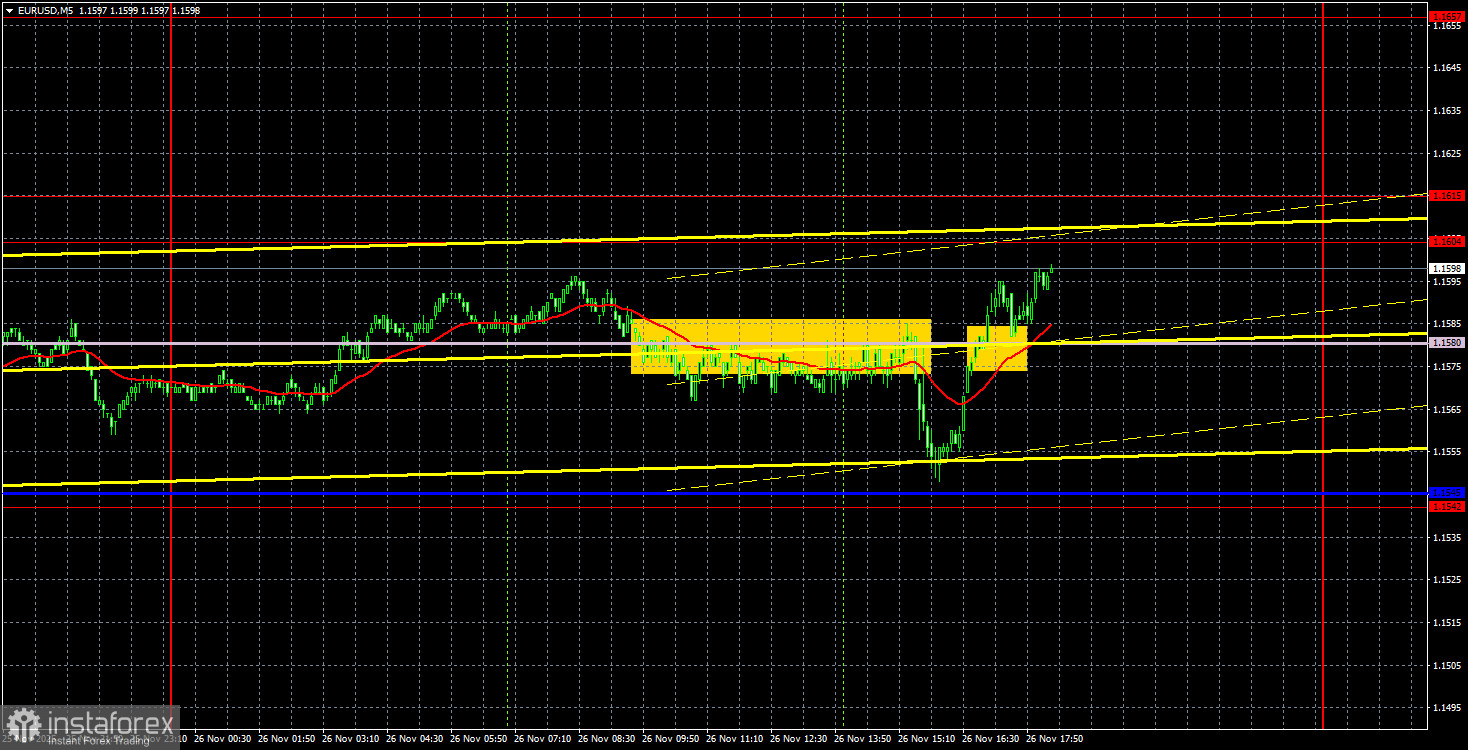
The EUR/USD currency pair experienced relatively good volatility for the second consecutive day on Wednesday. While we cannot say that the rise of the European currency was logical in terms of macroeconomic and fundamental factors, we have repeatedly stated that any upward movement at this moment is inherently logical, as the upward trend persists. Besides the upward trend, a flat pattern persists on the daily timeframe. Given that the price has dipped into the lower boundary (1.1400) twice in recent weeks, a reversal and purely technical growth was also plausible. Thus, yesterday's growth in the pair amid fairly decent U.S. statistics did not surprise us. Before beginning to rise, the pair went down after the one U.S. report that was dollar-positive. Orders for durable goods in September increased by 0.5% instead of the expected 0.2%, which prompted a slight strengthening of the dollar. However, the dollar has clearly exhausted its streak of good luck in recent weeks as the market has ignored news over the past two months. On the 5-minute timeframe, two trading signals were formed yesterday. First, the pair bounced off the Senkou Span B line, sending traders who, like us, were expecting growth into a panic. The price missed the Kijun-sen line by only a few pips, so the next signal was generated when the Senkou Span B line was breached. Whether it was worth opening long positions remains an open question, as the nearest target zone (1.1604-1.1615) was located nearby.

COT Report

Image

The last COT report was published last week and is dated October 7, making it, to put it mildly, outdated. The illustration above clearly shows that the net position of non-commercial traders has long been "bullish." Bears barely entered the zone of their own superiority at the end of 2024 but quickly lost it again. Since Trump took office for a second time, the dollar has been falling. We cannot say with 100% certainty that the decline of the U.S. currency will continue, but current global developments hint at just such a scenario. We still do not see any fundamental factors supporting the strengthening of the euro, but we do see enough factors supporting the decline of the dollar. The global downward trend still persists, but what significance does it have for the price movement over the last 17 years? The dollar could rise if the global fundamental picture changes, but currently, there are no signs of that. The positions of the red and blue lines in the indicator continue to show a bullish trend. Over the last reporting week, the number of longs in the "Non-commercial" group increased by 3,300, while the number of shorts increased by 2,400. Consequently, the net position increased by 900 contracts over the week. However, this data is already outdated and irrelevant.

Analysis of EUR/USD 1H

Image

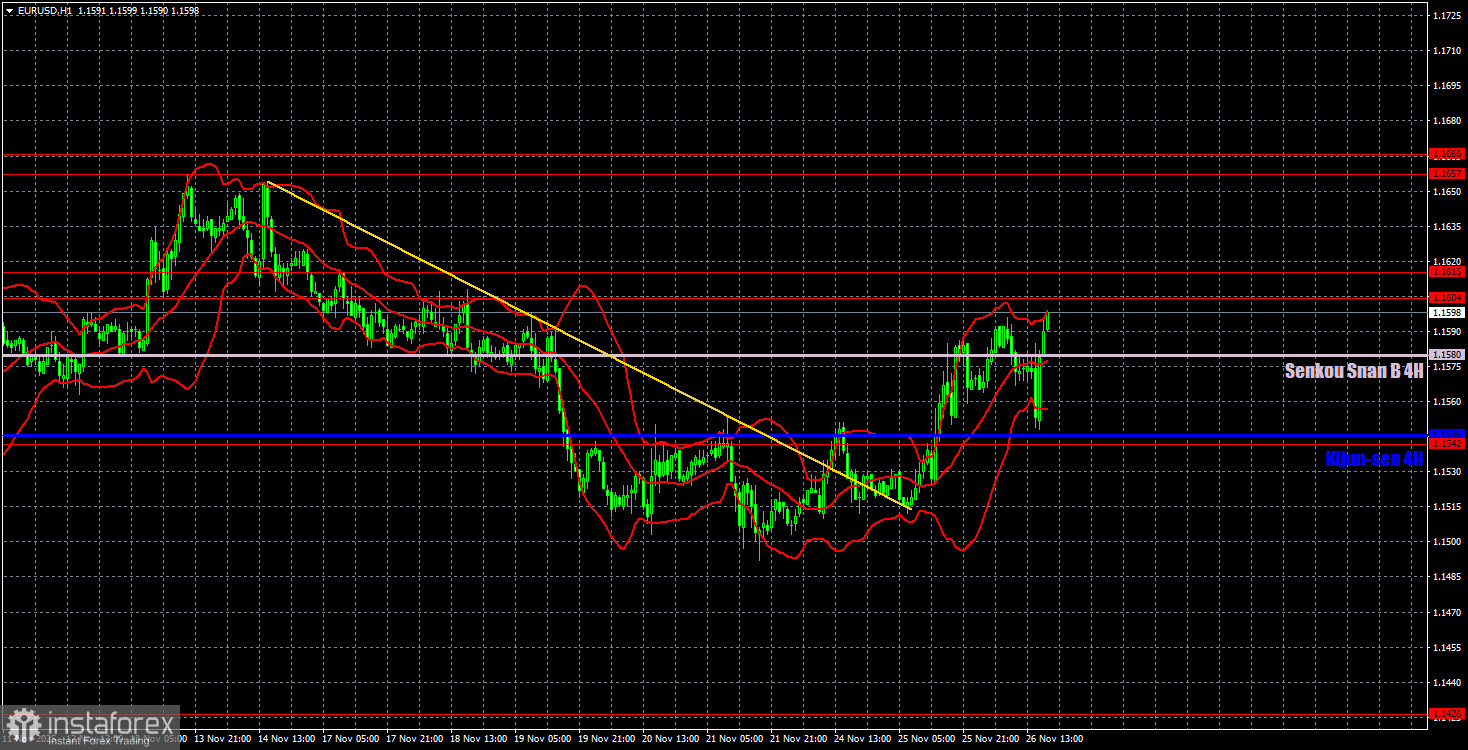
On the hourly timeframe, the EUR/USD pair has started to form an upward trend and has partially overcome the Senkou Span B line. The price remains within the sideways channel of 1.1400-1.1830 on the daily timeframe, so a rise of the euro to around 1.1800 may still occur even within the local trend. While the growth of the euro cannot be deemed strong, movements within a flat pattern are typically random and chaotic. For November 27, we identify the following trading levels: 1.1234, 1.1274, 1.1362, 1.1426, 1.1542, 1.1604-1.1615, 1.1657-1.1666, 1.1750-1.1760, 1.1846-1.1857, 1.1922, 1.1971-1.1988, as well as the Senkou Span B line (1.1580) and the Kijun-sen line (1.1545). The Ichimoku indicator lines may shift throughout the day, which should be taken into account when determining trading signals. Don't forget to set stop-loss orders to break even if the price moves in the desired direction by 15 pips. This will protect against potential losses if the signal turns out to be false. On Thursday, there are no significant events scheduled in either the European Union or the U.S. Therefore, volatility may remain minimal. If the euro continues to rise without news support, it will be a very good sign for the resumption of the global trend of 2025. Trading Recommendations: On Thursday, traders can trade from the area of 1.1604-1.1615. In the event of a rebound from this area, new sell opportunities can be considered with targets at the Senkou Span B line and the Kijun-sen line. In the event of a breakout of the area, buying can be considered with a target of 1.1657-1.1666.

Analysis are provided by InstaForex.

Read more: https://ifxpr.com/3Xlt5Jw
IFX Bella
 
Posts: 540
Joined: Sat Dec 08, 2012 12:39 am

Re: Instaforex Analysis

Postby IFX Bella » Fri Nov 28, 2025 3:53 am

Forex Analysis & Reviews: EUR/USD Overview. November 28. Euro's Growth Is Sluggish, Bulls Need a Boost

Image

The EUR/USD currency pair rose slowly but steadily on Wednesday and Thursday. On Wednesday, the macroeconomic background did not support the rise of the European currency; however, the bulls made an effort and pushed the pair up by several dozen pips. On Thursday, the macroeconomic background was completely absent, yet the euro appreciated by another couple of dozen pips. Thus, the euro is growing, albeit with great difficulty. The question is, how long will such a struggle for growth continue? We continue to expect only growth for the EUR/USD pair in the medium term, but the market has been in a total flat pattern for the past five months. Therefore, the number one task is to wait for the flat to end. A couple of weeks ago, the price dropped twice to the lower boundary of the sideways channel at 1.1400-1.1830, allowing for long positions to be opened. However, at the same time, no clear buy signal emerged, such as a retest of the 1.1400 level or a liquidity sweep at that level. The euro is rising now, but the basics of technical analysis tell us that as long as the last high has not been broken, the downward trend cannot be considered finished. Therefore, the current growth of the euro may be the beginning of a long and strong upward movement, or it could be just another "noise" within the sideways channel on the daily timeframe. Our expectations remain unchanged—only the decline of the U.S. dollar. It should be remembered that 2026 is approaching, and this year the Federal Reserve may conduct monetary easing in isolation, as the European Central Bank has already completed its easing cycle, and the Bank of England is unlikely to significantly lower the key rate next year. The UK needs to address the high inflation issue before lowering rates. The latest report signaled a slowdown in inflation, but this is only for one month, not a trend. Thus, the Fed will likely cut its rates much more aggressively than the ECB or the BoE. Furthermore, given that Jerome Powell will step down next year and a new head will be appointed by Trump to take his place, monetary easing may occur much more rapidly than many expect now. In the last two months, the market has desperately ignored all "bearish" factors for the dollar. However, we want to emphasize that this will not last forever. The market remains in a flat pattern, which explains the lack of reaction to many fundamental events. Nonetheless, we believe that the market will not forget about these events. The flat is a time for forming new positions. Therefore, market makers are preparing for a new trend. Frankly, it is difficult for us to envision a bullish dollar trend under the current circumstances in the U.S. On the 4-hour timeframe, the pair remains above the moving average, which allows for expectations of further upward movement. From our perspective, it is advisable not to disregard the current buying opportunities, as we may be witnessing the beginning of a new phase of the global upward trend.

Image

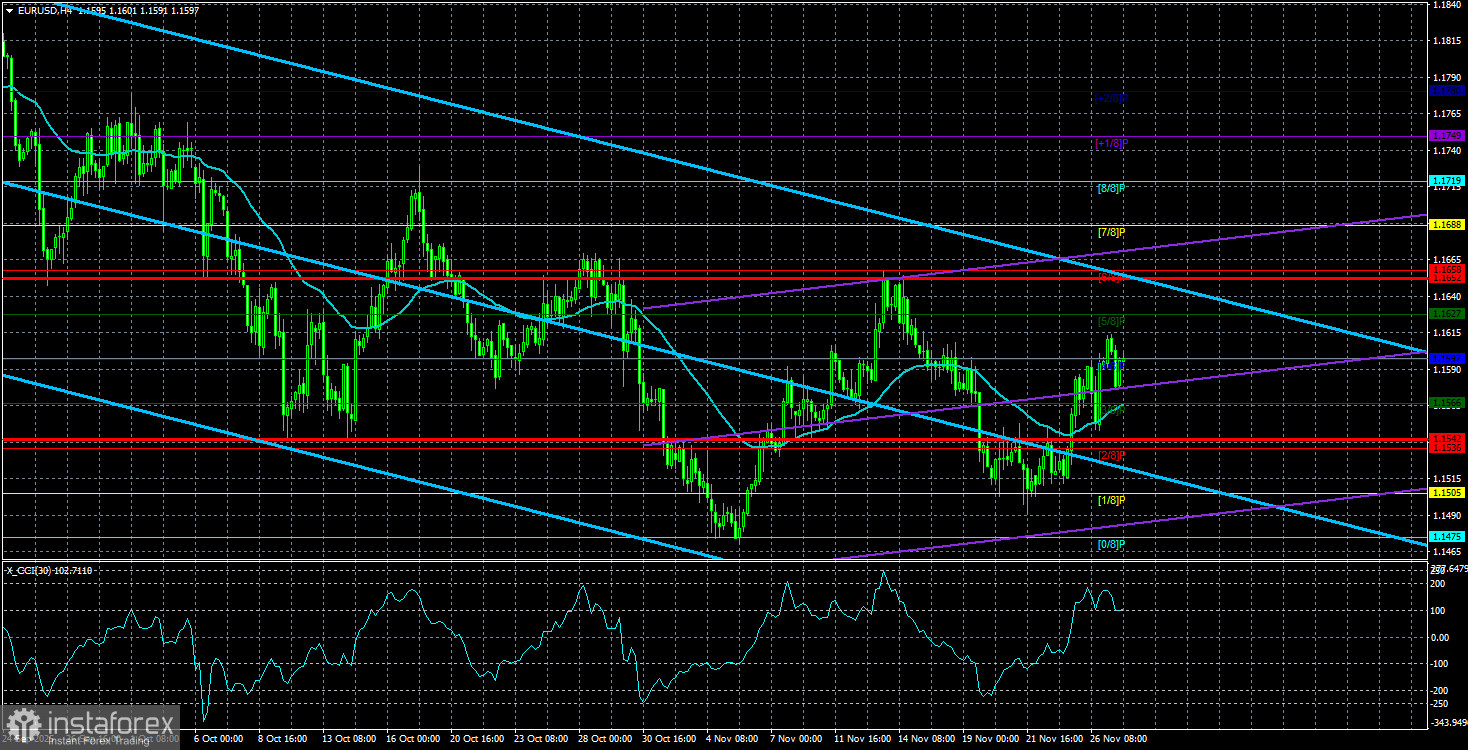
The average volatility of the EUR/USD currency pair over the last five trading days as of November 28 is 55 pips, which is considered "average." We expect the pair to trade between 1.1542 and 1.1652 on Friday. The upper linear regression channel is directed downwards, signaling a downward trend, but in fact, the flat continues on the daily timeframe. The CCI indicator entered the oversold zone twice in October, which may trigger a new phase of the upward trend in 2025. Nearest Support Levels: S1 – 1.1566 S2 – 1.1536 S3 – 1.1505 Nearest Resistance Levels: R1 – 1.1597 R2 – 1.1627 R3 – 1.1658 Trading Recommendations: The EUR/USD pair remains below the moving average, but the upward trend persists across all higher timeframes, while the daily timeframe has been flat for several months. The global fundamental background continues to exert a strong influence on the U.S. dollar. Recently, the dollar has been rising, but the reasons for this movement may be purely technical. Given the price is below the moving average, small short positions targeting 1.1505 can be considered on technical grounds. Above the moving average line, long positions remain relevant with a target of 1.1800 (the upper line of the flat on the daily timeframe). Explanations for Illustrations: Linear regression channels help determine the current trend. If both are directed in the same way, then the trend is currently strong; The moving average line (settings 20,0, smoothed) determines the short-term trend and the direction in which trading should currently be conducted; Murray levels are targeted levels for movements and corrections; Volatility levels (red lines) denote the probable price channel within which the pair will trade in the coming day, based on current volatility metrics; The CCI indicator entering the oversold area (below -250) or the overbought area (above +250) indicates that a trend reversal is approaching in the opposite direction.

Analysis are provided by InstaForex.

Read more: https://ifxpr.com/49KIN8i
IFX Bella
 
Posts: 540
Joined: Sat Dec 08, 2012 12:39 am

Re: Instaforex Analysis

Postby IFX Bella » Mon Dec 01, 2025 5:18 am

Forex Analysis & Reviews: GBP/USD Overview. Weekly Preview. No Non-Farms Again.

Image

The GBP/USD currency pair slightly corrected on Friday but retained its local upward trend. Currently, the pair may be at the very beginning of a new upward trend that will be part of the trend for 2025. From our perspective, the fundamental backdrop for the dollar has not changed in the second half of this year, and the dollar itself has extracted the maximum from local fundamentals and macroeconomic factors. It is also worth noting that the euro and the pound generally trade in the same direction and quite similarly. If the upward trend in the euro were to be reversed, we would have expected further declines in the British pound. However, as the euro remains in a flat range, it is impractical to talk about a downward trend for the pound until this flat is concluded. Recently, the pound has indeed faced significant pressure from UK macroeconomic data and events related to the approval of next year's UK budget. However, the budget has already been approved, and the macroeconomic data now are subpar both in the UK and the U.S. Therefore, if the global correction is complete, the pound will rise on almost any grounds, and the market will simultaneously remember both the "shutdown" and the "dovish" policy of the Federal Reserve, as well as the trade war. This week, there will be no important reports from the UK, and in the U.S., only a few reports that cannot be considered significant by any means. Traders are accustomed to the first week of each month being when unemployment data and Non-Farm Payrolls are released, which currently have a considerable influence on the Fed's decisions. However, this week, the mentioned reports are not scheduled in the economic calendars. On December 10 (next week), the Fed is set to meet. It appears that the Fed may once again have to act blindly. Of course, the event calendar can be adjusted, and the Bureau of Statistics could release reports before the Fed meeting. But as of now, the calendars are empty. The only significant reports are the ISM business activity indices for the services and manufacturing sectors. According to expert forecasts, both indices are expected to decline in November, and the manufacturing sector is already in recession, below the "waterline" of 50. On Wednesday, the ADP report for November will be published, and in the absence of Non-Farm Payrolls, the market and the Fed will once again have to rely solely on this report to gauge the state of the U.S. labor market. It is worth noting that this report is not the most accurate, as it does not account for certain sectors of the economy, and the market usually focuses on Non-Farm Payrolls. But "in the absence of fish, even a crayfish is a fish." Other reports include industrial production, the University of Michigan consumer sentiment index, and the core personal consumption expenditures (PCE) price index. However, in our view, these reports will not change market sentiment. If the correction is complete, we will see an increase regardless of the data. If not, we will witness a decline despite any data.

Image

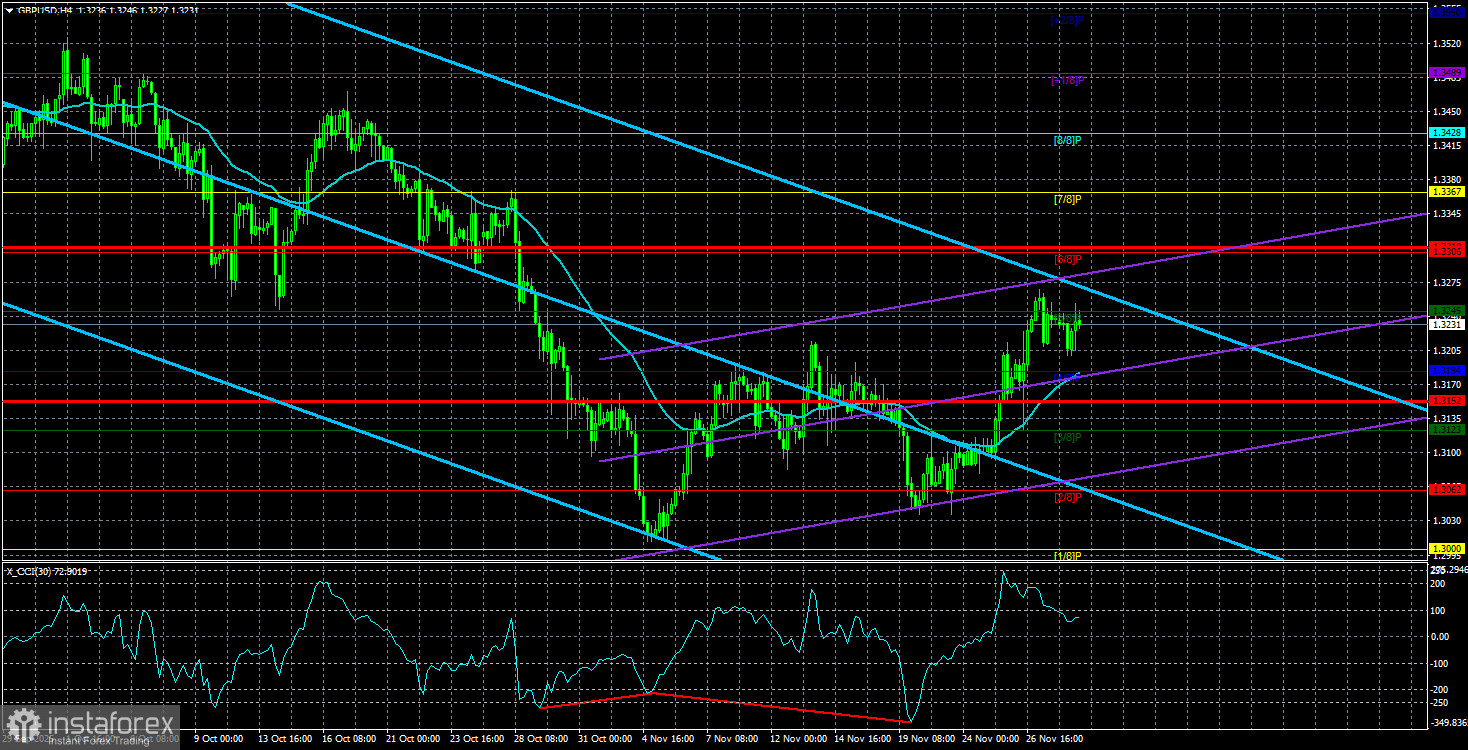
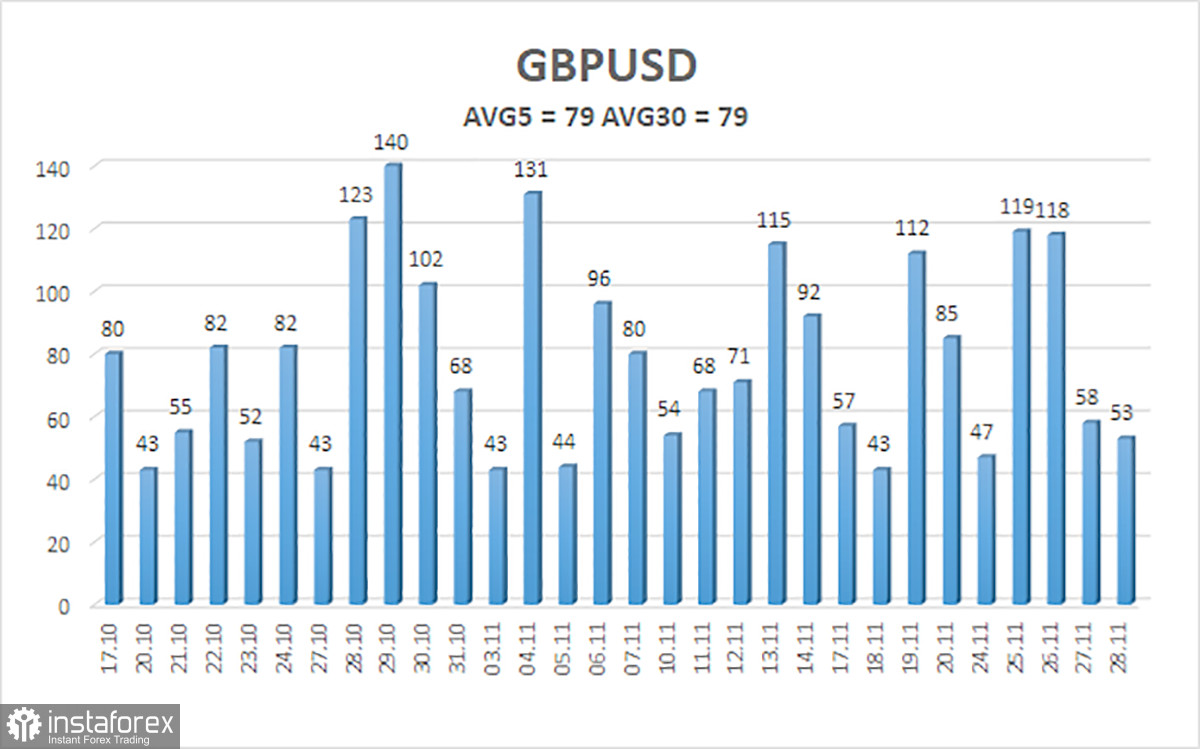
The average volatility of the GBP/USD pair over the last five trading days is 79 pips. For this pair, this value is considered "average." On Monday, December 1, we thus expect movement within the range bounded by levels 1.3152 and 1.3310. The upper channel of the linear regression is directed downward, but this is just due to the technical correction on higher timeframes. The CCI indicator has entered the oversold area six times in recent months and has formed yet another bullish divergence. Nearest Support Levels: S1 – 1.3184 S2 – 1.3123 S3 – 1.3062 Nearest Resistance Levels: R1 – 1.3245 R2 – 1.3306 R3 – 1.3367 Trading Recommendations: The GBP/USD currency pair is attempting to resume its upward trend for 2025, and its long-term prospects remain unchanged. Donald Trump's policies will continue to exert pressure on the dollar, so we do not expect the American currency to appreciate. Therefore, long positions with targets of 1.3306 and 1.3428 remain relevant for the near future while the price is above the moving average. If the price is below the moving average line, small short positions may be considered with a target of 1.3062 based on technical grounds. Occasionally, the American currency shows corrections (in a global sense), but for it to trend stronger, it needs signs that the trade war is ending or other global positive factors. Explanations for Illustrations: Linear regression channels help determine the current trend. If both are directed in the same way, it indicates a strong trend; The moving average line (settings 20,0, smoothed) defines the short-term trend and the direction in which trading should currently be conducted

Analysis are provided by InstaForex.

Read more: https://ifxpr.com/4pkMAOz
IFX Bella
 
Posts: 540
Joined: Sat Dec 08, 2012 12:39 am

PreviousNext

Return to Forex Brokers